
CBCL Alternatives for Broad Spectrum Child and Behavioral Emotional Assessment
Free, evidence-based, multi-informant screeners that match the CBCL and BASC-3’s broad-spectrum coverage — no licence, no per-report fee.
Written by Dr Elizabeth Rojas · Last updated July 2026
On this page
Clinical providers looking for CBCL alternatives or alternatives to the BASC-3 to assess youth behaviour and emotion need tools with broad coverage to screen, identify and assess risk for mental-health disorders. Effective child assessment tools should offer:
- Standardised screening for internalising and externalising problems across anxiety, mood, disruptive-behaviour, social and neurodevelopmental disorders.
- Assessment of impact across settings: peer and family relationships, academics, school and social interactions.
- Accurate, reliable measures that identify common co-occurring disorders and distinguish the influence of substance use or trauma and adverse childhood experiences.
- Multiple informant options — parents, caregivers and teachers — for collateral information that improves diagnostic accuracy.
- Efficient, rapid screening with guidance on further evaluation or diagnostic interviews where needed.
- Support for routine monitoring of symptoms, treatment response and outcomes.
No single tool can independently diagnose a client, and this is even more pronounced with youth. Evidence-based practice recommends a multi-informant, comprehensive set of measurement-based assessments — using tools that ease administrative burden with standard scoring, established clinical cut-offs, accurate comparison norms and minimal bias.
NovoPsych's freely available alternatives
These five measures cover common childhood behavioural and emotional disorders, offering variety and flexibility for broadband and disorder-specific assessment across the spectrum. All are current, evidence-backed, reliable screening and assessment tools, enabling ongoing symptom monitoring, treatment-response tracking and outcome measurement over time.
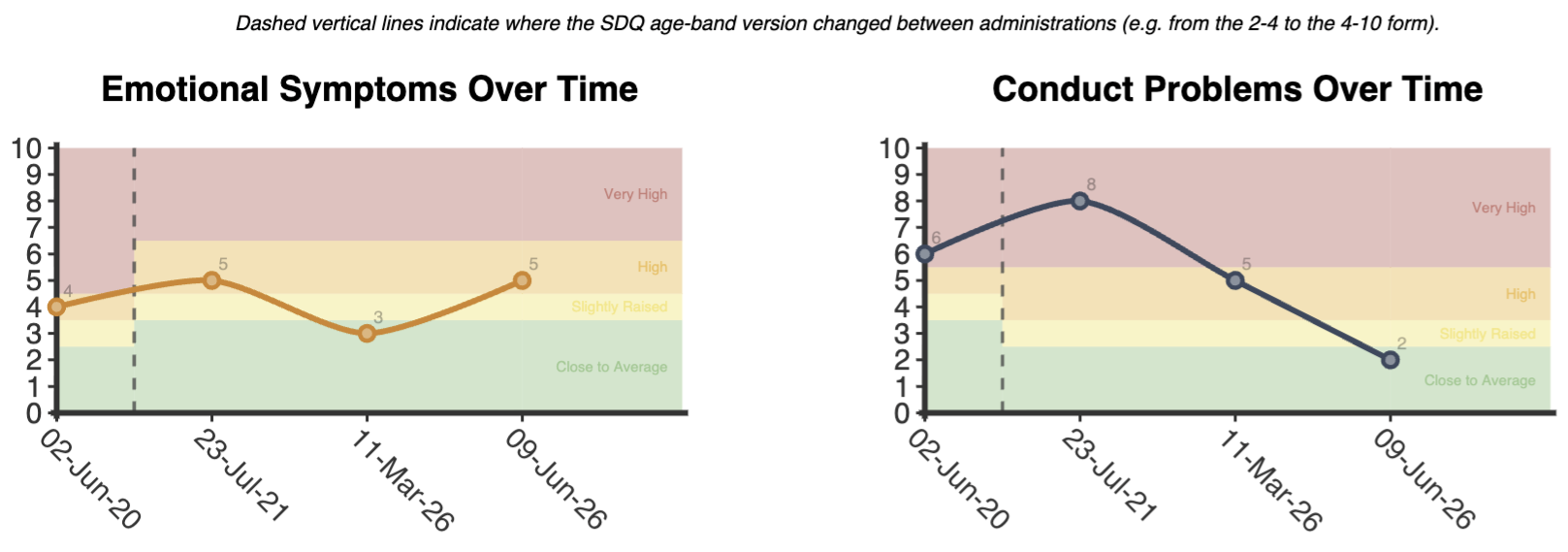
Brief 25-item multi-informant screen of emotional, conduct, hyperactivity and peer problems (plus prosocial strengths) in youth 2–17. Screens broadly, guides evaluation and tracks change over time.
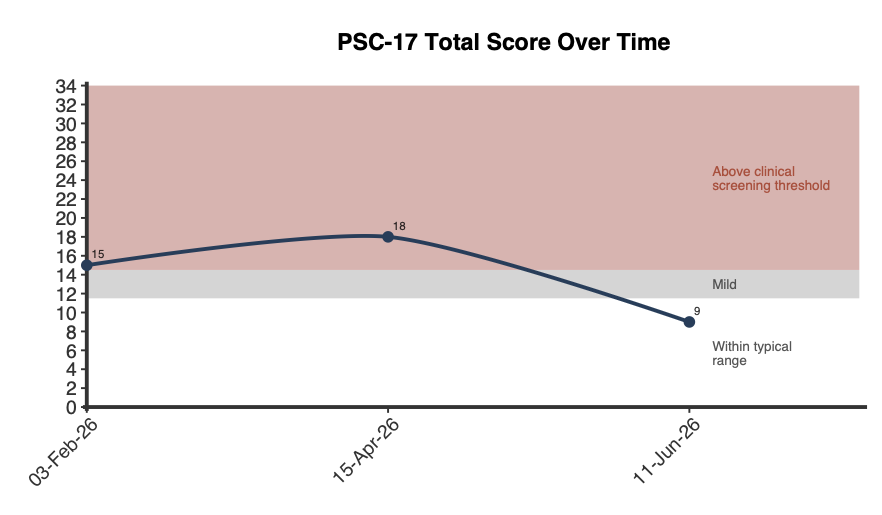
17-item parent/caregiver screen of internalising, attention and externalising problems in children 4–17 — brief broadband screening and measurement-based care.
Youth (8–17) self-report of depression, anxiety and stress with severity bands — dimensional distress screening and symptom monitoring.
47-item parent and child report mapping six DSM anxiety and depression subscales to normed T-scores — distinguishes co-occurring internalising disorders.
Parent and child anxiety report (ages 8–15) across six anxiety domains with age- and gender-matched T-scores — detects OCD and broad anxiety.

The CBCL and BASC: what you're comparing against
If you are evaluating the ASEBA CBCL or the BASC-3, here is what each offers — and where a free, validated NovoPsych battery covers the same clinical ground without the per-report licence.
ASEBA CBCL
A parent-report questionnaire for internalising/externalising problems in children 6–18, with companion youth self-report (YSR, 11–18) and teacher report (TRF). It yields Total Problems, Internalising and Externalising scores plus six DSM-oriented scales (Affective, Anxiety, Somatic, ADHD, Oppositional Defiant, Conduct), with normed T-scores.
Strengths: comprehensive multi-informant broadband assessment; good agreement with other broadband tools (SDQ, BASC-3); validity demonstrated across scale structures and cross-culturally.
The catch: low cross-reporter agreement; weaker diagnostic-accuracy evidence for the DSM-oriented scales; the recommended full ASEBA system (CBCL + TRF + YSR) carries per-use fees for each informant administration and report.
BASC-3 and BASC-4
The Behavior Assessment System for Children — a 105–192 item broadband battery spanning ages 2–21. It's a full behaviour assessment system rather than a single scale.
Strengths: very broad developmental and behavioural coverage; popular in schools and for IEP and learning-disability evaluations; integrates interview, history and observations.
The catch: independent research suggests scores largely reflect one general “behaviour problems” factor, limiting disorder-specific interpretation; length and per-report cost make it heavy for focused referrals.
See our full BASC comparison in the Conners alternatives article →
Selecting the right broad-spectrum tool
Some NovoPsych measures focus on internalising problems (RCADS, SCAS, DASS-Y), while others cover both internalising and externalising problems (SDQ, PSC-17). A single self-report measure is inherently limited and can misrepresent the clinical picture. The strongest approach combines broad and selective multi-informant assessments, using discrepancies between informants as clinical signals to distinguish co-occurring disorders and inform decision-making.
Consider the referral context, the youth’s demographics, which collateral informants are available, and the assessment or treatment goal. A youth showing behaviour problems at school, for example, may benefit from the SDQ parent and youth report — capturing both perspectives, especially where a parent minimises symptoms or the youth has limited self-insight.
How NovoPsych delivers the same capability — free
NovoPsych hosts the complete set of alternatives discussed here — and more than 150 others — with the same digital workflow clinicians expect from a paid platform, for free:
- Free PDFs of every measure — with digital administration, automated scoring and interpretive score reports.
- Normative reference scoring — accurate, standardised comparison and interpretation, built in.
- Packaged, multi-measure delivery — administer or send any combination of questionnaires to clients and informants simultaneously.
- Faithful digital translations — of the original, evidence-based paper forms.
- Customisable batteries — build and save your own assessment sets for specific referrals.
- NovoNote scribe with AI insights (JAN) — capture live interview information, generate combined summaries, and document behaviour-observation sessions with a custom school-observation template.
- Measurement-based-care support — repeat administrations flagged for score change, with auto-generated interpretive text.
Free — no per-report fee, no licence. For practices or individuals who would benefit from AI scribe services and further customisation, a free trial and tiered plan are available, including high-usage NovoNote and Just Ask NovoNote access for tailored, comparative multi-informant reports. Explore the NovoNote template library, an example school observation template and child cognitive assessment report, or learn more about NovoNote and Just Ask NovoNote.
How NovoPsych compares to the CBCL and BASC-3
Capability, norms and interpretation, and administration compared across NovoPsych (SDQ, PSC-17, DASS-Y, RCADS and SCAS), the ASEBA CBCL and the BASC-3.
| Feature | NovoPsych (SDQ · PSC-17 · DASS-Y · RCADS · SCAS) | ASEBA CBCL (PAR) | BASC-3 (Pearson) |
|---|---|---|---|
| Clinical capability | |||
| Broad DSM disorder symptom screening alignment | ✓ DSM-embedded criteria1 | ✓ DSM-oriented scales2 | ✓ DSM codes3 |
| Behaviour observation | ~ school-observation template4 | ~ separate DOF/TOF4 | ✓ Student Observation System |
| Co-occurring disorder differentiation | ✓ RCADS + SCAS, DASS-Y5 | ✓ | ✓ |
| Risk indicators (suicide, self-harm, substance use)6 | ✗ | ~ embedded substance item (YSR) | ~ Alcohol Abuse scale (SRP only) |
| Multi-informant (caregiver + teacher + self) | ✓ SDQ; RCADS/SCAS parent+child | ✓ CBCL + TRF + YSR | ✓ PRS + TRS + SRP |
| Psychosocial functioning impairment | ~ SDQ impact supplement | ~ parent form only | ✓ Adaptive Skills domain |
| Response-validity indices | ✗ | ✗ | ✓ |
| Age range | Varies 2–18 across measures7 | 1½–188 | 2–21 / 6–259 |
| Norms & interpretation | |||
| Normative reference samples (age, gender)10 | ✓ | ✓ | ✓ |
| Clinical reference sample11 | ✗ | ✗ | ✓ |
| Diagnostic-informed classification scoring (cutoffs, severity bands, percentiles) | ✓ | ✓ | ✓ |
| Measurement-based symptom monitoring / change tracking12 | ✓ | ~ separate Brief Problem Monitor | ~ separate Flex Monitor add-on |
| Platform & administration | |||
| Digital administration | ✓ | ~ ASEBA-Web add-on | ~ Q-global add-on |
| Automated digital scoring13 | ✓ | ~ | ~ |
| Interpretive clinical report14 | ✓ | ~ | ✓ |
| Item-level response display | ✓ | ~ | ✓ |
| Combined assessment clinical reports | ✓ | ✓ cross-informant bar graph | ✓ Multirater report |
| AI scribe / documentation integration15 | ✓ + NovoNote / JAN | ✗ | ✗ |
| Clinical interview integration | ✓ + NovoNote / JAN | ✗ | ~ SDH structured history aid |
| Licence required | None | Commercial | Commercial |
| Cost16 | Free* | Paid | Paid |
Key: ✓ present / full · ~ yes, with limitations · ✗ absent
Table notes
1. DSM symptom criteria — RCADS’s six subscales map to DSM-IV/5 anxiety and depression categories in parent and child forms; SDQ, PSC-17 and SCAS are broadband/dimensional rather than diagnosis-mapped; DASS-Y differentiates depression, anxiety and stress.
2. DSM-oriented scales — CBCL/TRF/YSR each yield six DSM-oriented scales (Affective, Anxiety, Somatic, ADHD, Oppositional Defiant, Conduct).
3. DSM codes — BASC-3 clinical scales map to broad constructs with DSM-suggested codes rather than literal DSM criterion counts.
4. Behaviour observation — NovoPsych offers a school-observation template usable with NovoNote; ASEBA sells the Direct Observation Form (DOF) and Test Observation Form (TOF) as separate instruments.
5. Anxiety subtypes — RCADS separates Separation Anxiety, Social Phobia, GAD, Panic and OCD in matched parent/child forms; SCAS separates six anxiety domains including physical-injury fears; DASS-Y separates depression, anxiety and stress.
6. Risk indicators — none of the five NovoPsych measures directly screen suicide, self-harm or substance use; CBCL/YSR includes one embedded substance item (best via YSR); BASC-3’s SRP has an Alcohol Abuse scale (self-report only). None include a dedicated suicide/self-harm scale.
7. NovoPsych age ranges — SDQ 2–17; PSC-17 4–16; DASS-Y 8–17; RCADS-Parent/Child 8–18; SCAS-Parent 7–13; SCAS-Child 8–15.
8. CBCL forms — CBCL/1½–5 and CBCL/6–18 (parent), TRF (teacher, 1½–18) and YSR (self, 11–18).
9. BASC-3 forms — TRS/PRS Preschool (2–5), Child (6–11) and Adolescent (12–21); SRP ages 6–25.
10. Normative reference sample — a general-population comparison group for percentile/T-score. SDQ UK N=7,984; PSC-17 US N=80,680 and AUS N=2,097; DASS-Y N=2,121; RCADS-Parent N=967; SCAS-Parent N=1,857; SCAS-Child N=4,916. CBCL and BASC-3 draw on large national stratified samples.
11. Clinical reference sample — BASC-3 includes disorder-specific clinical reference samples alongside general clinical norms.
12. Measurement-based monitoring — repeat administrations plotted over time. NovoPsych has reliable-change thresholds for PSC-17, DASS-Y and SCAS with auto-graphing; ASEBA’s Brief Problem Monitor and BASC-3’s Flex Monitor are separate add-ons.
13. Automated digital scoring — the platform calculates scores, applies norms and flags cut-offs without hand-scoring; ASEBA and BASC-3 require separate paid software (ASEBA-Web; Q-global).
14. Interpretive clinical report — an auto-generated narrative with norm-referenced profiles and item-level responses. BASC-3’s Q-global report is roughly $3.90–$4.80/use; ASEBA reports require separately purchased software.
15. AI scribe / documentation integration — results flow into notes, letters and reports via NovoNote templates and Just Ask NovoNote (JAN).
16. Cost — ASEBA CBCL paper forms run about $1/form, with scoring and reports requiring paid ASEBA software or a subscription; BASC-3 kits range ~$169–$1,300+, with Q-global scoring $3.90–$4.80/report and booklets ~$2.50 in bulk.
* No per-report fee and no licence under NovoPsych’s standard access model.
Frequently Asked Questions
What is the CBCL?
The Child Behavior Checklist (CBCL) is the parent-report component of the Achenbach System of Empirically Based Assessment (ASEBA), distributed by PAR. It screens internalising and externalising problems in children 6–18 (with a 1½–5 preschool form), alongside a companion youth self-report (YSR, ages 11–18) and teacher report (TRF) (Achenbach & Rescorla, 2001).
Scoring yields Total Problems, Internalising and Externalising T-scores plus six DSM-oriented scales (Affective, Anxiety, Somatic, ADHD, Oppositional Defiant and Conduct problems) referenced to national normative samples. The full recommended system (CBCL + TRF + YSR) carries per-use fees for each informant administration and report, with scoring via paid ASEBA software or subscription (paper forms ~$1/form).
What is the BASC-3?
The Behavior Assessment System for Children (BASC-3), and the newer BASC-4 published by Pearson, is a 105–192 item broadband battery spanning ages 2–21. It is a full behaviour assessment system rather than a single scale, integrating teacher (TRS), parent (PRS) and self-report (SRP) forms with interview, history and observation components. It is especially popular in schools for IEP, learning-disability evaluations, and assessing emotional/behavioral disturbances.
BASC-3 scoring runs through Pearson Q-Global (reports roughly $3.90–$4.80 per use; kits ~$169–$1,300+), with normative and clinical reference samples, response-validity indices, and an Adaptive Skills domain covering psychosocial functioning.
How accurate are the CBCL and BASC?
Both instruments are well-normed and widely validated. The CBCL shows good agreement with other broadband tools and cross-cultural validity (Goodman & Scott, 1999), but both carry documented limits. The CBCL’s cross-reporter agreement is low, and the diagnostic-accuracy evidence for its six DSM-oriented scales is weaker than its broadband scores (Ferdinand, 2008; Nakamura et al., 2009). For the BASC-3, independent research suggests scores largely reflect one general “behaviour problems” factor, limiting disorder-specific interpretation (Canivez, von der Embse & McGill, 2021).
The clinical takeaway is structural, not brand-specific: no single tool can independently diagnose a client, and this is even more pronounced with youth. Evidence-based practice recommends using a multi-informant, comprehensive set of measurement-based assessments with standard scoring, established clinical cut-offs, accurate comparison norms, and informant discrepancies to guide clinical evaluation.
References
Achenbach, T. M., & Rescorla, L. A. (2001). Manual for the ASEBA School-Age Forms & Profiles. University of Vermont, Research Center for Children, Youth, & Families.
Arendt, K., Hougaard, E., & Thastum, M. (2014). Psychometric properties of the child and parent versions of the Spence Children’s Anxiety Scale in a Danish community and clinical sample. Journal of Anxiety Disorders, 28(8), 947–956.
Chorpita, B. F., Moffitt, C., & Gray, J. (2005). Psychometric properties of the Revised Child Anxiety and Depression Scale in a clinical sample. Behaviour Research and Therapy, 43(3), 309–322.
Chorpita, B. F., Yim, L. M., Moffitt, C. E., Umemoto, L. A., & Francis, S. E. (2000). Assessment of symptoms of DSM-IV anxiety and depression in children: A Revised Child Anxiety and Depression Scale. Behaviour Research and Therapy, 38(8), 835–855.
Chromik, M., & Friedman, M. (2026). Concurrent validity of the CBCL DSM-oriented scales in psychiatric care. Clinical Child Psychology and Psychiatry, 31(2), 143–155.
de Ross, R. L., Gullone, E., & Chorpita, B. F. (2002). The Revised Child Anxiety and Depression Scale: A psychometric investigation with Australian youth. Behaviour Change, 19(2), 90–101.
DeSousa, D. A., Zibetti, M. R., Trentini, C. M., Koller, S. H., Manfro, G. G., & Salum, G. A. (2014). Screen for child anxiety related emotional disorders: Are subscale scores reliable? A bifactor model analysis. Journal of Anxiety Disorders, 28(8), 966–970.
Ebesutani, C., Bernstein, A., Nakamura, B. J., Chorpita, B. F., & Weisz, J. R. (2010). A psychometric analysis of the Revised Child Anxiety and Depression Scale — Parent version in a clinical sample. Journal of Abnormal Child Psychology, 38(2), 249–260.
Ebesutani, C., Chorpita, B. F., Higa-McMillan, C. K., Nakamura, B. J., Regan, J., & Lynch, R. (2011). A psychometric analysis of the Revised Child Anxiety and Depression Scales — Parent version in a school sample. Journal of Abnormal Child Psychology, 39(2), 173–185.
Ferdinand, R. F. (2008). Validity of the CBCL/YSR DSM-IV scales Anxiety Problems and Affective Problems. Journal of Anxiety Disorders, 22(1), 126–134.
Gardner, W., Lucas, A., Kolko, D. J., & Campo, J. V. (2007). Comparison of the PSC-17 and alternative mental health screens in an at-risk primary care sample. Journal of the American Academy of Child & Adolescent Psychiatry, 46(5), 611–618.
Goodman, R. (1999). The extended version of the Strengths and Difficulties Questionnaire as a guide to child psychiatric caseness and consequent burden. Journal of Child Psychology and Psychiatry, 40(5), 791–799.
Goodman, R., Ford, T., Corbin, T., & Meltzer, H. (2004). Using the SDQ multi-informant algorithm to screen looked-after children for psychiatric disorders. European Child & Adolescent Psychiatry, 13(Suppl. 2), II/25–II/31.
Goodman, R., Ford, T., Simmons, H., Gatward, R., & Meltzer, H. (2000). Using the Strengths and Difficulties Questionnaire to screen for child psychiatric disorders in a community sample. British Journal of Psychiatry, 177(6), 534–539.
Goodman, R., & Scott, S. (1999). Comparing the Strengths and Difficulties Questionnaire and the Child Behavior Checklist: Is small beautiful? Journal of Abnormal Child Psychology, 27(1), 17–24.
Hawes, D. J., & Dadds, M. R. (2004). Australian data and psychometric properties of the Strengths and Difficulties Questionnaire. Australian and New Zealand Journal of Psychiatry, 38(8), 644–651.
Ishikawa, S., Sato, Y., & Sasagawa, S. (2013). Anxiety disorder symptoms in Japanese children and adolescents. Journal of Anxiety Disorders, 27(2), 227–235.
Jacobson, J. H., Pullmann, M. D., Parker, E. M., & Kerns, S. E. U. (2019). Measurement-based care in child welfare-involved children and youth: Reliability and validity of the PSC-17. Child Psychiatry & Human Development, 50(6), 941–953.
Jiang, Y., et al. (2023). Factor structure and psychometric properties of the Spence Children’s Anxiety Scale: A systematic review. Frontiers in Psychiatry, 14.
Kostanecka, A., Power, T., Clarke, A., Watkins, M., Hausman, C. L., & Blum, N. J. (2008). Behavioral health screening in urban primary care settings: Construct validity of the PSC-17. Journal of Developmental & Behavioral Pediatrics, 29(2), 124–128.
Lacalle, M., Ezpeleta, L., & Domènech, J. M. (2012). DSM-oriented scales of the Child Behavior Checklist and Youth Self-Report in clinically referred Spanish children. Spanish Journal of Psychology, 15(1), 377–387.
Lavigne, J. V., Gouze, K. R., Hopkins, J., Bryant, F. B., & LeBailly, S. A. (2016). Parenting and anxiety: Bi-directional relations in young children. Journal of Clinical Child & Adolescent Psychology, 45(4), 464–477.
Li, H. C., Chan, S. L., & Chung, O. K. (2011). Psychometric properties of the Chinese version of the Spence Children’s Anxiety Scale in Hong Kong. Journal of Clinical Psychology, 67(8), 812–823.
Magiati, I., et al. (2017). Anxiety symptoms in youth with autism spectrum disorder: Factor structure of the Spence Children’s Anxiety Scale. [Citation details to be confirmed.]
McLean, R. K., Tully, L. A., & Dadds, M. R.; Growing Minds Australia—Clinical Trials Network. (2025). Reliability, predictive validity and normative data for the Pediatric Symptom Checklist-17 in a national Australian sample. Australian & New Zealand Journal of Psychiatry, 59(8), 702–712.
Mellor, D. (2005). Normative data for the Strengths and Difficulties Questionnaire in Australia. Australian Psychologist, 40(3), 215–222.
Murphy, J. M., Bergmann, P., Chiang, C., Sturner, R., Howard, B., Abel, M. R., & Jellinek, M. (2016). The PSC-17: Subscale scores, cutpoints, and factor structure in a new national sample. Pediatrics, 138(3).
Nakamura, B. J., Ebesutani, C., Bernstein, A., & Chorpita, B. F. (2009). A psychometric analysis of the Child Behavior Checklist DSM-oriented scales. Journal of Psychopathology and Behavioral Assessment, 31(3), 178–189.
Nauta, M. H., Scholing, A., Rapee, R. M., Abbott, M., Spence, S. H., & Waters, A. (2004). A parent-report measure of children’s anxiety: Psychometric properties and comparison with child-report in a clinic and normal sample. Behaviour Research and Therapy, 42(7), 813–839.
Orbay, Ö., & Ayvaşik, H. B. (2006). Psychometric properties of the Spence Children’s Anxiety Scale — Parent Report in a Turkish sample. Türk Psikoloji Yazıları, 9(18), 33–48.
Radez, J., Waite, P., Chorpita, B., Creswell, C., Orchard, F., Percy, R., Spence, S. H., & Reardon, T. (2021). Using the 11-item version of the RCADS to identify anxiety and depressive disorders in adolescents. Research on Child and Adolescent Psychopathology, 49(9), 1241–1257.
Shabani, M. J., Gharraee, B., & Zahedi Tajrishi, K. (2025). Psychometric properties of the Persian version of the Depression Anxiety Stress Scales for Youth (DASS-Y). Journal of Psychopathology and Behavioral Assessment.
Skarphedinsson, G., Smárason, O., Weidle, B., Hojgaard, D. R. M. A., Torp, N. C., Ivarsson, T., Nissen, J. B., & Thomsen, P. H. (2021). Younger versus older children with obsessive-compulsive disorder: Symptoms, severity and impairment. Journal of Obsessive-Compulsive and Related Disorders, 29.
Spence, S. H. (1998). A measure of anxiety symptoms among children. Behaviour Research and Therapy, 36(5), 545–566.
Stoppelbein, L., Greening, L., Moll, G., Confer, A., & Puffer, S. (2012). Factor analyses of the Pediatric Symptom Checklist-17 in a NICHD study of early child care. Journal of Pediatric Psychology, 37(9), 998–1008.
Szabo, M., & Lovibond, P. F. (2022). Development and psychometric properties of the DASS-Youth (DASS-Y): An extension of the Depression Anxiety Stress Scales to adolescents and children. Frontiers in Psychology, 13, Article 766890.
Śliwerski, A., Koszałkowska, K., & Socha, K. (2025). Assessing stress, anxiety, and depression in children and adolescents: Validation of the DASS-Y in Poland. Frontiers in Psychiatry, 16, Article 1512401.
Whiteside, S. P., & Brown, A. M. (2008). Exploring the utility of the Spence Children’s Anxiety Scale parent- and child-report forms in a North American sample. Journal of Anxiety Disorders, 22(8), 1440–1446.
Whiteside, S. P., Gryczkowski, M., Biggs, B. K., Fagen, K., & Owusu, D. (2012). Validation of a measure to identify OCD in youth using the Spence Children’s Anxiety Scale. Journal of Anxiety Disorders, 26(1), 173–178.