

Developed through validation with over 1,000 Australian professional athletes, the APSQ provides sport-specific screening for mental health concerns that uniquely affect athletic populations (Rice et al., 2020).

Elite athletes encounter distinctive psychological challenges that differ from general populations. These include intense performance pressures, career uncertainty, injury-related distress, selection anxiety, and the psychological demands of maintaining peak physical conditioning. The APSQ was developed to address the limitations of generic mental health measures that may not capture the unique manifestations of psychological strain in athletic contexts. Traditional screening tools often emphasise internalised symptoms that may be perceived as intrusive or stigmatising by athletes, potentially limiting disclosure and help-seeking behaviours. The APSQ addresses this gap by incorporating sport-relevant language and domains that resonate with athletes’ lived experiences. The scale comprises three distinct subscales that capture different dimensions of athlete psychological strain:
Research demonstrates that APSQ scores correlate strongly with psychological distress as measured by established instruments, whilst maintaining sport-specific relevance. The scale shows robust associations with general distress measures (Rice et al., 2020; Rice, Olive, et al., 2020). Importantly, the APSQ has been incorporated into the International Olympic Committee’s Sport Mental Health Assessment Tool (SMHAT-1), establishing its international recognition as a gold-standard screening instrument for athlete populations (Gouttebarge et al., 2021).
Sports psychologists and mental health clinicians utilise the APSQ for multiple clinical purposes: conducting routine mental health screening throughout training and competition cycles, identifying athletes at risk before symptoms escalate to clinical thresholds, monitoring psychological strain during vulnerable periods such as injury rehabilitation or career transitions, and informing targeted interventions based on specific strain domains. For instance, an athlete scoring highly on the Performance subscale but low on other domains might benefit from performance psychology interventions, whilst elevated External Coping scores may indicate a need for substance use screening and harm reduction strategies. The scale’s brevity and sport-specific focus facilitate integration into comprehensive athlete health assessments, supporting cultures of high performance whilst prioritising psychological safety and wellbeing (Taylor et al., 2012).
A total score is given ranging from 10 to 50. Higher scores indicate greater psychological strain and distress. Subscale scores are also available with ranges below:

Raw scores are converted into average scores, indicating the average response for each question.
A percentile score is presented based upon sex from the data provided by Rice et al. (2020). Cut off scores to assist in interpretation are provided by Rice et al. (2020):
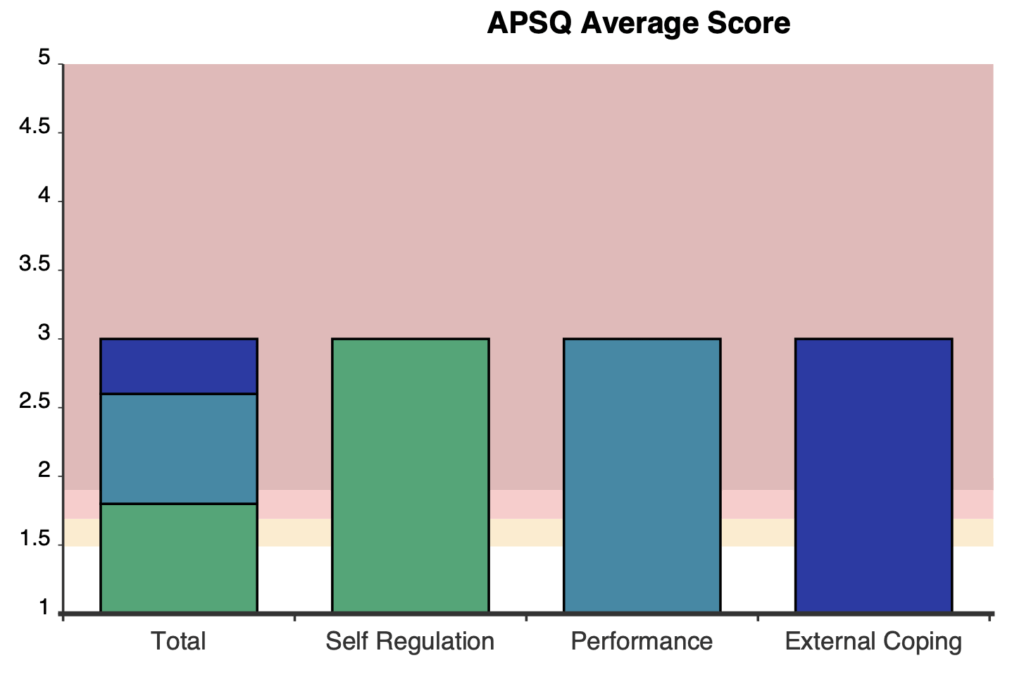
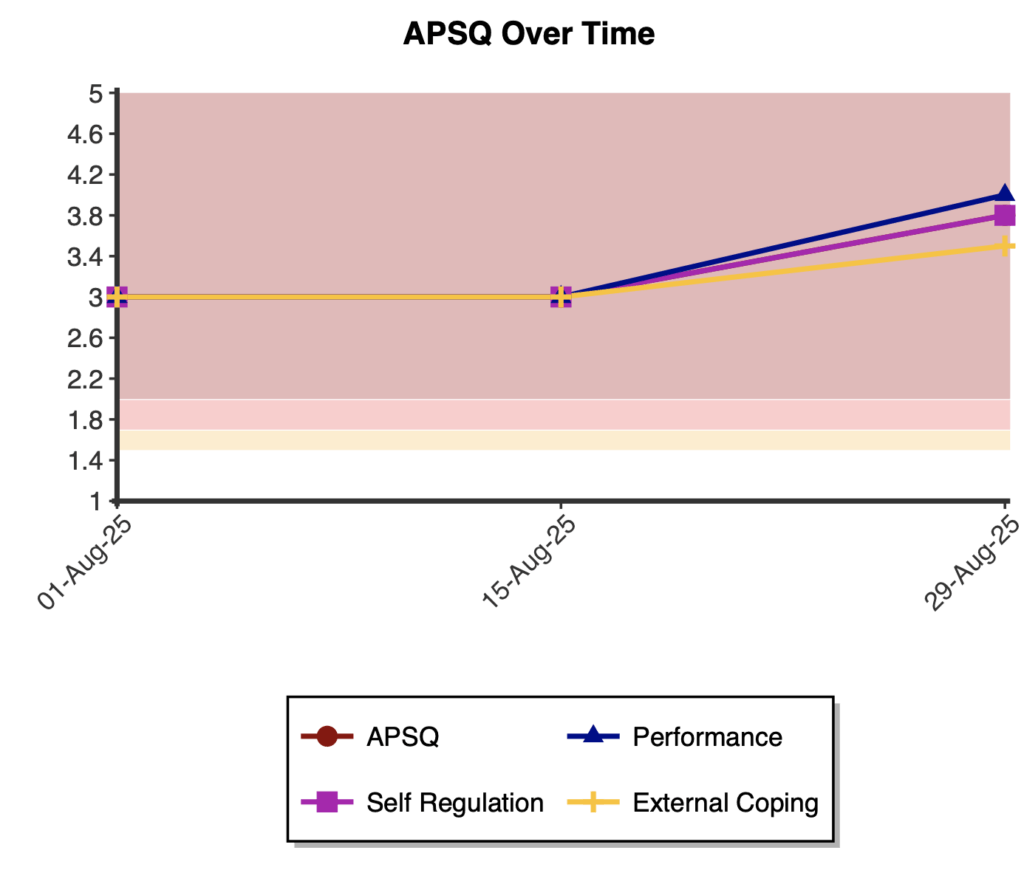
On first administration, a stacked bar graph of the total and subscale average scores is shown. For multiple administrations, a line graph of the total and subscale average scores is produced to track changes over time.
The APSQ demonstrates robust psychometric properties across multiple validation studies with elite athlete populations. Construct validity has been extensively established through convergent and divergent validity testing. The scale shows strong convergent validity with the Kessler-10 psychological distress measure, with correlations ranging from 0.70 to 0.73 across male and female professional athletes. Divergent validity is supported through negative correlations with the Warwick-Edinburgh Mental Well-Being Scale (r = -0.226 to -0.495), confirming that the APSQ appropriately measures distress rather than wellbeing (Rice et al., 2020; Rice, Olive, et al., 2020).
Internal consistency reliability is strong across gender groups, with Cronbach’s alpha coefficients of 0.81 for male athletes and 0.84 for female athletes in elite samples. The APSQ total score demonstrates superior internal consistency compared to the K-10 when used with athletic populations (α = 0.87 for males, 0.84 for females), suggesting enhanced reliability for sport-specific assessment. Subscale reliabilities are also acceptable: Self-Regulation (α = 0.74-0.82), Performance (α = 0.72-0.74), and External Coping (α = 0.68-0.80) (Rice, Olive, et al., 2020; Gouttebarge et al., 2021).
Factor analytic studies support the three-factor structure of the APSQ. Initial exploratory factor analysis with 497 elite athletes identified the three-factor solution, which was subsequently confirmed through confirmatory factor analysis with an independent sample of 510 athletes. The model demonstrated excellent fit indices (CFI = 0.976, TLI = 0.966, RMSEA = 0.055, SRMR = 0.032), with all three subscales loading onto a higher-order “Athlete Psychological Strain” factor. Differential item functioning analysis revealed no significant bias across education levels or ethnicity, supporting the scale’s measurement equivalence across diverse athlete groups (Rice et al., 2020).
Recent research has extended validation to collegiate athlete populations. Yang and Parent’s work with United States collegiate athletes demonstrated similar factor structure and reliability, supporting the scale’s utility beyond elite professional contexts. The APSQ maintained strong psychometric properties in this younger athletic population, though measurement invariance testing across gender groups in collegiate samples warrants further investigation (Yang & Parent, 2025).
Normative data is available from Rice et al. (2020):


