

The DAR-5’s items address these dimensions of anger reactions: (1) frequency, (2) intensity, (3) duration, (4) aggression and (5) interference with social functioning. It was developed to provide a brief, psychometrically sound measure of anger that minimises burden on both clients and practitioners whilst maintaining clinical utility. The DAR-5 was derived from the original 7-item DAR (Novaco, 1975) to create a concise measure retaining the most clinically relevant items. The DAR-5 has since been validated both in general/nonclinical samples and in trauma-exposed and clinical PTSD groups, indicating that it can be used as a general anger screener and is particularly useful where trauma-related anger is a concern.
DAR-5 Example Item
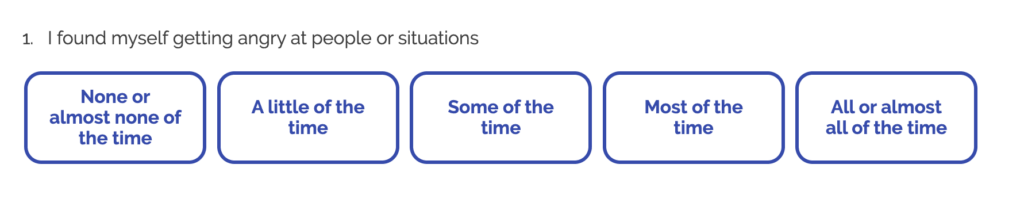
Anger is increasingly recognised as a common and clinically important component in reaction to traumatic events. Research has consistently demonstrated that anger co-occurs with post-traumatic stress disorder (PTSD) across diverse trauma-exposed populations, including combat veterans, survivors of sexual and physical assault, motor vehicle accidents, refugee experiences, and exposure to human rights violations (Novaco et al., 2012; Feeny et al., 2000; Mayou et al., 2002; Hinton et al., 2009; Silove et al., 2009). The presence of problematic anger not only results in significant personal distress but also interferes with recovery from trauma and negatively impacts treatment outcomes for PTSD (Forbes et al., 2008). Meta-analytic findings suggest that anger, particularly inhibited or undisclosed anger, is specifically associated with PTSD rather than trauma exposure alone (Olatunji et al., 2010; Orth & Wieland, 2006). These findings underscore the importance of routinely assessing anger in post-trauma care.
Research findings support the clinical utility of the DAR-5 in trauma-exposed populations. Studies have consistently demonstrated strong associations between elevated DAR-5 scores and PTSD symptom severity, with high-anger individuals reporting significantly higher levels of intrusion, avoidance, negative alterations in cognitions and mood, and alterations in arousal and reactivity (Forbes et al., 2014; Asmundson et al., 2016). The DAR-5 has also demonstrated associations with broader psychological distress, depression, and reduced quality of life, confirming that problematic anger extends its impact beyond trauma-specific symptoms (Forbes et al., 2014; Goulart et al., 2021). Importantly, the scale has been found to be sensitive to change associated with therapeutic interventions for PTSD, making it valuable for monitoring treatment response and assessing outcomes.
Clinicians can use the DAR-5 as a brief screening and monitoring tool to identify individuals who may benefit from anger-specific interventions. Problematic anger issues function as a barrier to trauma recovery, for trauma-exposed clients presenting with elevated anger, addressing these difficulties may be an essential component of effective PTSD treatment. The scale can also inform treatment planning by highlighting specific aspects of anger that are most problematic for an individual, such as whether difficulties centre primarily on anger intensity, duration, or interpersonal consequences.
The DAR-5 produces a total score ranging from 5 to 25. Higher scores indicate greater levels of problematic anger.

Score interpretation is guided by an established empirical cut-off (12+), in addition to percentile rankings within serving personnel and clinical PTSD samples for comparison.
Upon the first administration of the DAR-5, a bar graph displaying the total raw score is presented with serving personnel percentile labels on the right-hand side.

A second graph is shown displaying the client’s score relative to serving personnel as well as those with PTSD. This helps interpret whether a client’s anger reactions are within the range typically observed in serving personnel, or whether they reflect the more severe and persistent anger characteristic of clinical PTSD.
When the assessment is administered multiple times, a longitudinal line graph is generated to track changes in the total raw score over time.

When tracking DAR-5 score changes across administrations, clinicians can evaluate treatment response and the effectiveness of anger-focused interventions. A shift of approximately 2 points or more suggests meaningful improvement, following minimally important difference guidelines (Turner et al., 2010). This corresponds to approximately half a standard deviation. The scale has demonstrated sensitivity to change following PTSD treatment, with reductions in anger scores observed alongside improvements in PTSD symptoms.
Interpretation at the item level may also be clinically useful. Examining patterns across these dimensions can inform treatment planning. For example, high frequency scores with relatively low intensity and aggression ratings may suggest chronic irritability rather than explosive anger. Additionally, elevated duration scores relative to other items may suggest difficulties with rumination or emotion regulation that could benefit from cognitive restructuring interventions.
The original DAR measured anger frequency, intensity, duration, and antagonism, along with three ‘impairment’ items assessing the perceived negative impact of anger on work performance, social relationships, and health (Forbes et al., 2004). Validation research by Forbes and colleagues (2004) identified that two items could be removed without compromising psychometric properties, and that the original 9-point response scale could be simplified. The resulting DAR-5 retained the anger frequency, intensity, duration, and antagonism items and the social relationship impairment item, as the interpersonal domain has been suggested to be where anger dysregulation causes the most significant negative impact (Forbes et al., 2014).
The DAR-5 demonstrates robust construct validity through strong associations with established measures of anger. Convergent validity has been consistently established through correlations with the State Trait Anger Expression Inventory-2 (STAXI-2), which is widely accepted as a valid measure of anger. Across validation studies, the DAR-5 has shown its strongest correlations with STAXI-2 Trait Anger (r = .62 to .79), followed by Anger Expression-Out (r = .52 to .73) and State Anger (r = .41 to .51; Forbes et al., 2004; Forbes et al., 2014; Asmundson et al., 2016). These patterns conform to the conceptualisation of the DAR-5 as an anger disposition index that primarily assesses trait-like tendencies to experience frequent, intense, and lasting anger reactions. The scale demonstrates expected negative correlations with STAXI-2 Anger Control subscales (r = -.36 to -.65), further supporting its construct validity (Forbes et al., 2014).
Discriminant validity has been established through comparisons with measures of related but distinct constructs. Studies have found that whilst the DAR-5 correlates significantly with depression measures, these correlations (r = .37 to .46) are significantly lower than correlations with anger-specific measures, confirming that the scale assesses anger rather than general distress (Forbes et al., 2014; Goulart et al., 2021). The DAR-5 successfully differentiates between high and low scorers on PTSD symptom measures, with trauma-exposed individuals classified as having high anger reporting significantly greater PTSD symptom severity across all symptom clusters. Effect sizes for these differences range from medium to large (Cohen’s d = 0.72 to 1.24), providing strong evidence for the scale’s ability to identify clinically significant anger (Forbes et al., 2014; Asmundson et al., 2016).
Importantly, the relationship between DAR-5 scores and PTSD severity does not differ by gender, with both women and men showing similar associations between anger and post-traumatic stress symptoms (Asmundson et al., 2016). Factor structure invariance analyses have confirmed that the unitary structure of the DAR-5 remains stable across gender, and differential item functioning analyses have found no evidence of gender-based response bias at either the item or scale level (Asmundson et al., 2016).
The DAR-5 demonstrates excellent internal consistency across diverse samples and study contexts. Cronbach’s α values have ranged from .73 to .91, with most validation studies reporting values above .85. In the initial validation with college students, internal consistency was α = .90 for the overall sample and α = .89 for the trauma-exposed subsample (Forbes et al., 2014). In combat veterans with PTSD, the scale achieved α = .86 (Forbes et al., 2014). Studies in community samples have reported internal consistency of α = .73 in Brazilian primary care attenders (Goulart et al., 2021) and α = .91 in trauma-exposed American community adults (Asmundson et al., 2016). Item-total correlations typically range from .31 to .89, with the antagonism item consistently showing the lowest correlations (.31 to .72) and intensity and duration items showing the highest (.61 to .89).
Test-retest reliability has been examined in a Brazilian community sample, where an intraclass correlation of r = .73 was observed over an unspecified interval, indicating acceptable temporal stability (Goulart et al., 2021). The scale has also demonstrated sensitivity to change in the context of PTSD treatment, with significant reductions in DAR-5 scores observed following therapeutic intervention in veteran samples (Forbes et al., 2004).
Confirmatory factor analyses have consistently supported a unidimensional structure for the DAR-5 across multiple populations and cultural contexts (Forbes et al., 2014; Goulart et al., 2021; Asmundson et al., 2016). In the original validation with college students, a single-factor model provided an excellent fit for both the overall and the trauma-exposed subsample (Forbes et al., 2014). Validation in trauma-exposed community adults yielded similarly strong fit indices, confirming the appropriateness of a single-factor solution (Goulart et al., 2021; Asmundson et al., 2016).
Clinical data for the DAR-5 were obtained from a USA sample of males with PTSD (n = 163) reported by Forbes et al. (2014). Participants were all diagnosed using the Clinician-Administered PTSD Schedule (CAPS), and obtained a mean total DAR-5 score of 15.7 (SD = 4.4) (Blake et al. 1998). The sample had a mean age of 59.9 years (SD = 5.7, range 25-81 years).
Normative data for the DAR-5 comes from currently serving military personnel from a combined Australian and US samples reported by Forbes et al. (2025). This service personnel sample (n = 32,851) consisted of active duty military members who were currently serving at the time of assessment. The combined sample had a mean total DAR-5 score of 7.65 (SD = 3.65). This sample provides a meaningful comparison point as it represents individuals who may have experienced some trauma exposure through military service but are nonetheless remaining in active duty roles.
The established cut-off score of 12 on the DAR-5 was derived by Forbes et al. (2014) using the State-Trait Anger Expression Inventory-2 (STAXI-2) as a reference standard anchored at the 75th percentile, corresponding to the STAXI-2 manual’s indication that scores above this level signify anger associated with psychological distress and functional impairment (Spielberger, 1999). The cutoff of 12 demonstrates a substantial difference between clinical PTSD and serving personnel samples (approximately 2.2 standard deviations), supporting the notion that problematic anger is particularly prominent in individuals with diagnosed PTSD (Forbes et al., 2014; Forbes et al., 2025).
The established cut-off of 12 falls at approximately the 88th percentile among a sample of currently serving military personnel and the 20th percentile among individuals with PTSD. This suggests that a score of 12 effectively identifies problematic anger in general populations, and that many individuals with PTSD may score above it.
It is important to note that the DAR-5 was validated specifically in trauma-exposed samples. For individuals without trauma exposure who complete this measure, the clinical meaning of elevated scores remains uncertain. Clinicians should exercise caution when interpreting high scores in non-trauma contexts and consider whether other factors may be contributing to anger difficulties. The scale is most appropriately used with individuals who have experienced potentially traumatic events, where it can help identify anger as a trauma-related difficulty requiring attention.


