

Adult Attachment and Its Clinical Implications: Working with Attachment Dysfunction in Practice
Why adult separation anxiety is more common than panic disorder — and how to screen for it
Here is a scenario that will be familiar to many clinicians: a client in their late twenties presents with what looks like generalized anxiety. They worry constantly about their partner’s safety when apart, they call repeatedly to confirm plans, they find it almost physically difficult to go to work knowing their partner is at home alone. They’ve had CBT. It helped a bit. But something in the formulation never quite clicked. The diagnosis on the referral says “generalized anxiety.”
What is often missing from the picture is a structured understanding of adult attachment and adult separation anxiety disorder (SEPAD) — two constructs that are clinically significant, well-researched, and consistently underdiagnosed (Shear et al., 2006). Adult attachment theory and its clinical implications deserve a prominent place in the assessment and treatment toolkit of mental health professionals.
Adult Attachment Theory: Bowlby, Ainsworth, and Beyond
Bowlby’s original attachment theory proposed that the drive to seek proximity to protective caregivers is a hardwired mammalian survival strategy (Bowlby, 1969, 1982). Ainsworth’s later work with infants identified three core attachment styles — Avoidant (A), Secure (B), and Ambivalent/Resistant (C) — based on how children responded to brief separations from their mothers (Ainsworth et al., 1978). Main and Solomon subsequently added a fourth: Disorganized/Disoriented (D), characterizing children who could not approach their caregiver even when distressed — a pattern now understood as a precursor to significant later psychopathology (Main & Solomon, 1986).
What is well-established, and clinically important, is the evidence for continuity between childhood and adult attachment styles. The patterns laid down in infancy — shaped by parenting quality, temperament, trauma, and early separations — do not simply dissolve at eighteen. They migrate into adult intimate relationships, into the therapeutic relationship, and into the ways clients experience distress (Fraley, 2002).


The webinar Adult Attachment and Its Clinical Implications: Working with Attachment Dysfunction in Practice, presented by Dr Vijaya Manicavasagar, walks through SEPAD domains in depth — from the developmental origins of attachment styles and their continuity into adulthood, through to the clinical presentation of SEPAD, the barriers to its recognition, and practical guidance on using the ASA-27 in clinical assessment and formulation. Whether you are new to attachment-informed practice or looking to sharpen your diagnostic lens for presentations that have never quite resolved, this webinar is a valuable resource.
The distance between a misdiagnosis and the right formulation is sometimes just one question about who the client is most afraid of losing.
Adult Separation Anxiety
For much of the twentieth century, separation anxiety disorder was classified as a childhood condition. The DSM-5 and ICD-11 have since corrected this. SEPAD is now formally recognized as an anxiety disorder that can manifest at any point in the lifespan — and the epidemiological data are striking. Lifetime prevalence of SEPAD in adults is 6.6%, making it more common than both panic disorder (4.7%) and generalized anxiety disorder (5.7%) (Shear et al., 2006). Critically, 76% of adults with SEPAD reported adult onset, typically before age 30 — meaning the disorder is not simply a childhood condition that has persisted, but one that frequently begins in adulthood.
The clinical presentation in adults is subtler than in children, and that subtlety is the reason it gets missed. Where a child refuses school, an adult finds reasons not to travel. Where a child clings, an adult insists their partner provide precise information about their daily whereabouts. Sleep rituals, excessive reassurance-seeking, physical symptoms when anticipating separation, and recurrent nightmares with themes of loss or abandonment — these are not quirks of personality. They are the recognizable signature of a disorder that treatment-as-usual for panic or GAD will not adequately address (Manicavasagar & Silove, 2020).
Why SEPAD Gets Missed — And Why It Matters
SEPAD is regularly mistaken for panic disorder with agoraphobia, OCD, health anxiety, or GAD. The symptom overlap is genuine. What is less acknowledged is that treating these comorbid conditions without addressing underlying separation anxiety typically produces a suboptimal result. Conventional CBT for panic disorder rarely improves separation anxiety symptoms. The engine driving the presentation remains untouched.
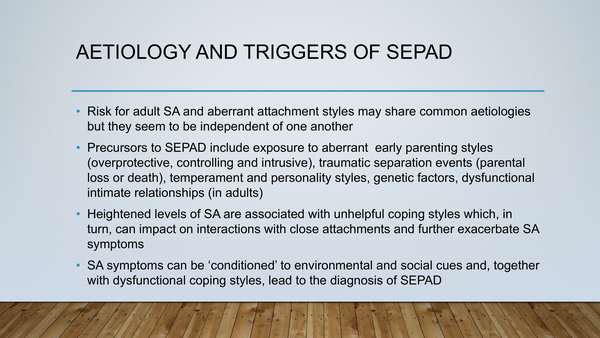
This is not a minor clinical inconvenience. Unaddressed heightened separation anxiety creates ongoing vulnerability to relapse, elevates functional impairment — particularly in the context of trauma and grief — and maintains the insecure relational patterns that perpetuate the cycle. A cycle, it should be noted, that is somewhat self-reinforcing: heightened SA → intense attachments → insecure relationships → dysfunctional coping → heightened SA. The diagram practically draws itself (Manicavasagar et al., 2009).
Patients are also frequently reluctant to disclose these symptoms. They are embarrassed. They have normalized the experience. Family and cultural factors may act as structural enablers. GP referrals rarely flag adult separation anxiety as a presenting concern. This places the diagnostic responsibility squarely with the receiving clinician — which is a compelling argument for wider screening of adult separation anxiety.

Lifetime prevalence of SEPAD in adults is 6.6% — more common than panic disorder and generalized anxiety disorder."
Shear et al., 2006
Assessing Adult Separation Anxiety
The most well-validated self-report measure for adult separation anxiety is the Adult Separation Anxiety Questionnaire (ASA-27), a 27-item instrument developed by Manicavasagar and colleagues (Manicavasagar et al., 2003) and available on the NovoPsych platform. The ASA-27 taps the behavioral, emotional, and cognitive dimensions of adult SA, with strong psychometric properties: Cronbach’s alpha of 0.95, test-retest reliability of 0.86, and sensitivity and specificity of 81% and 84% respectively at a cut-off score of 22. It can also be used as a pre- and post-treatment measure.
A score at or above the cut-off is suggestive of SEPAD — but, as with all self-report tools, it is a clinical prompt rather than a definitive diagnosis. The ASA-27’s real utility is also in opening conversations: about sleep rituals the client has never thought to mention, about the anxious phone calls that have become so routine neither the client nor their partner questions them anymore, about fears of illness or death that are really, at their core, fears of permanent separation.

Attachment Style, Separation Anxiety, and the Therapeutic Relationship
One point easily overlooked is that attachment style and separation anxiety are related but distinct constructs. Research has found that the correlation between high adult SA and specific attachment styles is inconclusive — the two constructs appear to be independent of one another (Manicavasagar et al., 2009). A client can have a secure attachment style and still develop SEPAD following a traumatic loss. Conversely, insecure attachment does not inevitably produce diagnosable separation anxiety.
What this means clinically is that understanding a client’s attachment style informs formulation and therapeutic relationship dynamics, while screening for adult SA informs diagnosis and treatment targets — and both are worth doing. Attachment-informed practice asks not just “what symptoms does this client have?” but “how does this client experience closeness, safety, and the threat of loss?” Those questions, asked well, shift the entire clinical frame. They also explain why a client who presents as avoidant, disengaged, or inexplicably resistant to a working therapeutic alliance is not being deliberately difficult. They may simply be someone for whom closeness has historically carried a cost.
The Attachment Style Questionnaire – Short Form (ASQ-SF) and related attachment measures available in NovoPsych’s assessments can provide a structured starting point for this kind of attachment-informed assessment.
Clinical Takeaway for Adult Attachment and Separation Anxiety
Adult attachment theory is not an abstract developmental framework — it is a clinical tool. Understanding how a client’s attachment history shapes their current relational patterns, their experience of the therapeutic relationship, and their response to separation and loss has practical implications for formulation, treatment planning, and outcome. Adult SEPAD, meanwhile, is more prevalent than most commonly recognized anxiety disorders and is under-screened in clinical settings. When it is present and unaddressed, it undermines treatment response across the board.
The webinar Adult Attachment and Its Clinical Implications: Working with Attachment Dysfunction in Practice, presented by Dr Vijaya Manicavasagar, walks through each of these domains in depth — from the developmental origins of attachment styles and their continuity into adulthood, through to the clinical presentation of SEPAD, the barriers to its recognition, and practical guidance on using the ASA-27 in clinical assessment and formulation. Whether you are new to attachment-informed practice or looking to sharpen your diagnostic lens for presentations that have never quite resolved, this webinar is a valuable resource.
Because the distance between a misdiagnosis and the right formulation is sometimes just one question about who the client is most afraid of losing.
View over 150 of the current psychometric assessments & tools available on NovoPsych.
Warm regards,
Dr Ben Buchanan
Psychologist
NovoPsych Co-founder
[email protected]
LinkedIn