The Ask Suicide-Screening Questions (asQ) is a widely used, validated suicide risk screener that gives clinicians a fast and reliable way to identify people who may be at risk of suicide and connect them with appropriate assessment. It is designed to be asked directly by a clinician as a routine part of care, and produces a clear screening outcome rather than a symptom or severity score.
The four core screening items, answered ‘Yes’ or ‘No’, ask about:
If a response of ‘Yes’ is provided to any of these four items, the acuity item is administered:
Example asQ Item

Suicide is a major and largely preventable cause of death. Worldwide, suicide is the third leading cause of death among people aged 15 to 29 (World Health Organization, 2025). A central challenge is that suicide risk frequently goes undetected in routine care. Most people who die by suicide have seen a healthcare provider in the year before their death, the majority within the preceding three months, yet they often present for other reasons and rarely raise suicidal thoughts unless asked directly (Horowitz et al., 2012). These contacts are opportunities to identify risks that are easily missed when suicide is not asked about directly.
Asking directly about suicide is both safe and necessary. Patients and families also generally report that being screened is acceptable (Ballard et al., 2012; Ross et al., 2016). Contrary to a common concern, asking about suicidal thoughts does not induce or increase them (Horowitz et al., 2014). Brief, validated screening tools such as the asQ are designed to make the assessment process routine, so that any trained clinician can quickly and reliably identify risk and direct those who screen positive to appropriate assessment.
A screener, not a diagnostic tool. The asQ is a screener, not a diagnostic or severity measure. It produces no symptom score: a positive result means this person needs further assessment, not that this person has a diagnosis.
In practice, use of the asQ is the brief first step in identifying suicide risk. A clinician asks the four questions directly and scores the result on the spot, typically in under two minutes (Horowitz et al., 2012). A key principle is the recommendation to administer the asQ with everyone, routinely, in the same matter-of-fact way a clinician takes a blood pressure, rather than reserving it for people who “seem” at risk, because suicide risk usually cannot be detected by observation alone. It is feasible for use even across an entire health system, where around 2.9 percent of paediatric encounters screened positive, rising to 8.5 percent in the emergency department (Roaten et al., 2020).
Where the asQ has been validated. The asQ has been validated in emergency departments (Horowitz et al., 2012), inpatient medical and surgical wards (Horowitz et al., 2020a, 2020b), and outpatient specialty and primary care clinics (Aguinaldo et al., 2020). It is now translated into more than 20 languages (National Institute of Mental Health, n.d.), including a validated Amharic version (Denberu et al., 2026).
A primary value of the asQ is its ability to detect risk that other suicide assessment approaches miss. In one emergency department study, more than half of the patients who screened positive using the asQ had not presented with any suicide-related concern (Ballard et al., 2017). Their risk would never have surfaced for the reason they came in. The asQ also detects people that depression screening overlooks. Around a third of those who screen positive for suicide risk do not screen positive for depression (Horowitz et al., 2021; Mournet et al., 2021).
Considerations for outpatient mental health settings. The asQ was developed as a universal suicide risk screener intended for use across healthcare settings and is included in the NIMH asQ Toolkit for emergency, inpatient, and outpatient care (National Institute of Mental Health, n.d.). The strongest evidence for the asQ comes from medical settings, including emergency departments, inpatient medical and surgical units, and outpatient specialty and primary care clinics, where it has demonstrated strong classification accuracy and feasibility for routine screening (Horowitz et al., 2012; Aguinaldo et al., 2020; Horowitz et al., 2020a, 2020b).
Direct validation within outpatient mental health services remains limited. In outpatient mental health practice, where clients present specifically with psychological concerns and baseline suicide risk is often higher than in general medical settings, the asQ is best viewed as a brief, standardised screening tool that complements rather than replaces comprehensive clinical risk assessment. Because outpatient services typically lack the immediate escalation infrastructure available in hospital settings, it is recommended that practices establish clear procedures before implementation, including who conducts follow-up assessment, how acute positive screens are managed, and which crisis resources are provided. Results should always be interpreted by a clinician within the context of a broader suicide risk evaluation and the service’s existing safety protocols.
The following considerations support the accurate, consistent, and safe administration of the asQ, and reflect the standardised procedures set out in the NIMH asQ Toolkit and its supporting materials (IHSgov, 2025; Horowitz et al., 2012; National Institute of Mental Health, n.d.).
The above points are intended as a brief overview rather than a complete guide for asQ administration. The full NIMH asQ Toolkit (www.nimh.nih.gov/asQ), which is freely available, sets out the complete administration procedures, suggested scripts, and clinical pathways. In practice, the asQ is generally designed to be used alongside each service’s own clinical protocols and procedures.
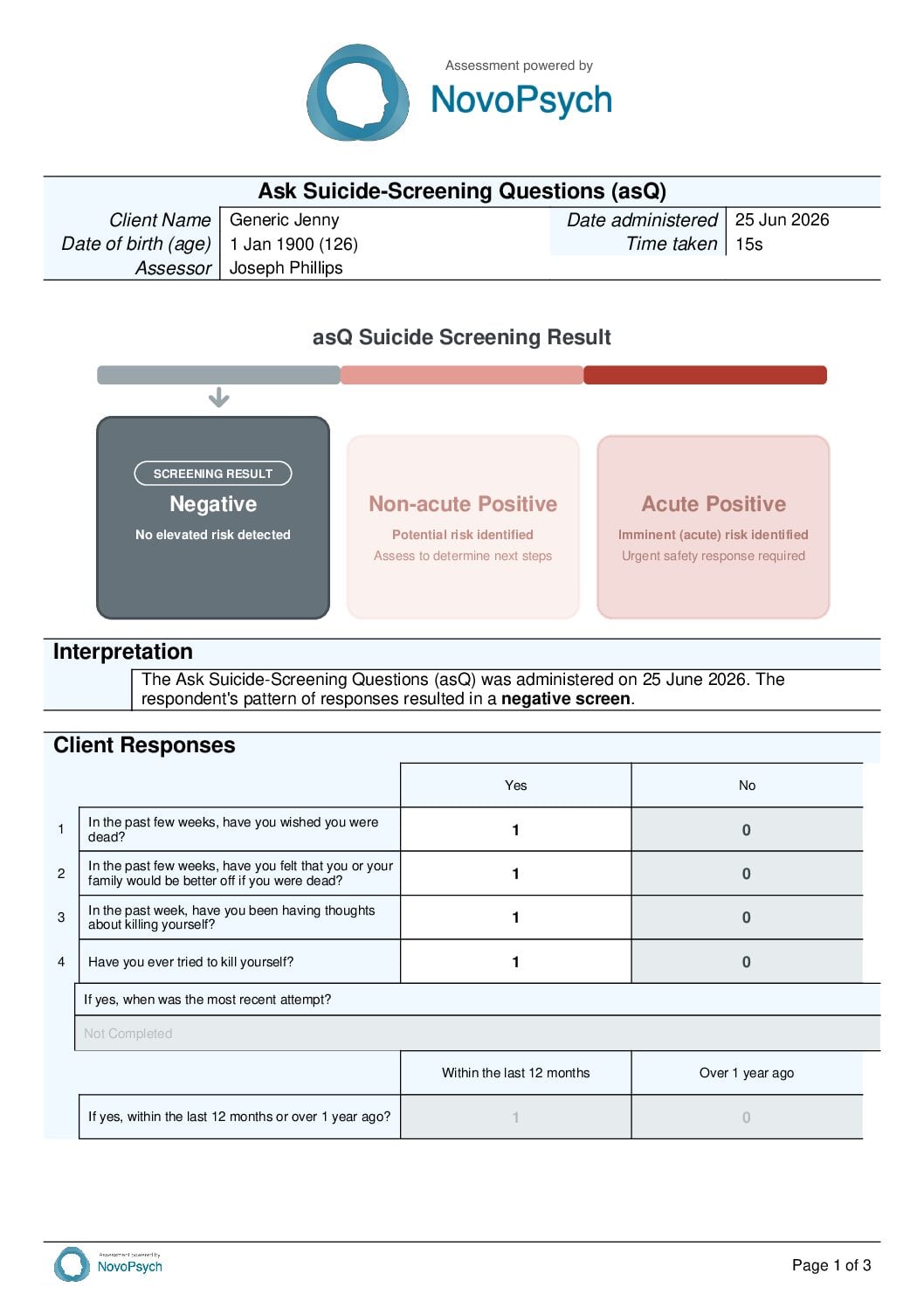
The asQ is not scored on a numerical scale. There is no total score, and no percentile or normative comparison applies. Each of the four core items is answered ‘Yes’ or ‘No’, and two items carry conditional follow-ups:

The asQ produces one of three results:
Clinicians who would like more detailed guidance on responding to each screen result can refer to the NIMH asQ Toolkit (www.nimh.nih.gov/asQ). It is a freely available resource that outlines suggested next steps, along with administration scripts, screening pathways for a range of settings, a Brief Suicide Safety Assessment (BSSA), and other guidance. These materials may be used as they are, alongside existing processes, or as a starting point for developing protocols.
The developers note that the single most common positive presentation is a ‘Yes’ to the lifetime-attempt item alone, accounting for between a third and a half of positive screens (IHSgov, 2025). Recency is therefore important to capture, as a remote past attempt with no current ideation may carry a different clinical meaning from a recent one.
Most research on the asQ shows that it agrees with longer structured suicide risk assessments at the time of screening. A smaller body of evidence goes further and shows that a positive asQ screen (i.e., a ‘Yes’ to any of the four core items, regardless of the acuity item) also predicts suicide-related outcomes later on. In a paediatric emergency department study, the asQ identified 93% of the young people who went on to return to the ED with a suicide-related problem within the following six months, including many who had originally presented for something unrelated (Ballard et al., 2017). In a larger study of 15,003 young people aged 8 to 18, those who screened positive were roughly five to seven times more likely to have a later suicide-related hospital visit than those who screened negative (hazard ratios of 4.8 to 6.8, depending on whether all patients or only selected patients were screened; DeVylder et al., 2019). In other words, a positive asQ is not just an accurate snapshot of current risk. It also flags young people at greater risk of suicide-related difficulties in the months that follow. This predictive evidence currently comes from paediatric and emergency settings, so it is strongest for youth in medical settings.
Single administration. The report presents the screen result as one of the three defined categories (negative, non-acute positive, or acute positive). If the response to item 4 was ‘Yes’, the results will note whether the most recent suicide attempt occurred within the last 12 months or over a year ago.
Repeat administration. The report presents the current result in the same way. Additionally, there is a display of screen results over time, plotting each administration as a discrete marker so that shifts between negative, non-acute positive, and acute positive status are visible at a glance. This graph serves as a record of risk status across screenings, ordered by acuity, rather than as a measure of symptom change; no change score is calculated.

Beyond the overall screen result, a review of individual item responses is important, in particular the free-text responses to items 4 and 5. Item 4’s follow-up prompts (when the most recent attempt occurred) and item 5’s description of current suicidal thoughts provide context that the screen category alone cannot convey, helping to establish acuity and determine appropriate next steps.
The asQ was developed by Horowitz and colleagues (2012) through a prospective study conducted across three urban paediatric emergency departments. The study drew on a sample of 524 patients aged 10 to 21 who presented with either medical or psychiatric concerns. From an initial pool of 17 candidate questions tested against the Suicidal Ideation Questionnaire (SIQ; a longer self-report criterion measure of suicidal ideation), the final four items were selected as those that best identified elevated suicide risk while keeping the screen brief enough for routine use.
Validation across age groups. The asQ was developed and first validated in young people aged 10 to 21, across emergency, inpatient, and outpatient settings (Horowitz et al., 2012; Horowitz et al., 2020a; Aguinaldo et al., 2020). Most participants in these studies were adolescents, so a separate study focusing on preteens aged 10 to 12 is notable, as it found that younger children also screen positive at meaningful rates, highlighting the potential value of suicide risk screening in this age group (Lanzillo et al., 2019). The authors later described the asQ as “a brief tool for all ages,” reflecting evidence supporting its use across both youth and adult populations (Horowitz et al., 2020b; National Institute of Mental Health, n.d.).
It is worth distinguishing what the research has established from what the developers recommend in practice. The published validation evidence covers ages 10 and above, while the developers recommend screening everyone aged 8 and older. In an outpatient psychiatric crisis clinic, clinicians judged the asQ developmentally inappropriate for a substantial share of younger children, around 30 percent of 8-year-olds and more than half of 6 and 7-year-olds, but rarely for those aged 10 to 12, and concluded that a developmentally adapted screener is needed for preteens, particularly those aged 10 and younger (Sarkisian et al., 2026).
Internal consistency of the asQ has been reported at a Cronbach’s alpha of approximately .93 (Horowitz et al., 2020a). Although this supports the cohesiveness of the four asQ items, internal consistency is less central to evaluating the asQ than classification accuracy because the tool is designed as a categorical suicide-risk screener rather than a dimensional severity scale. Test-retest reliability has not been established, as the asQ captures current risk status that is expected to change over time. Its evidence base, therefore, rests primarily on classification accuracy, which is presented in the sections below.
The asQ has a strong and varied evidence base for its validity as a screen. The main lines of evidence are summarised below.
Concurrent criterion validity. Compared against longer, validated measures of current suicide risk given at the same time, the asQ performs strongly. In the original paediatric emergency department study, it showed a sensitivity of 96.9 percent and a specificity of 87.6 percent against the SIQ, with a negative predictive value of 99.7 percent (Horowitz et al., 2012). In paediatric medical and surgical inpatients (N = 600), it showed a sensitivity of 96.7 percent, a specificity of 91.1 percent, a negative predictive value of 99.8 percent, and an area under the curve of 0.94 (Horowitz et al., 2020a). In youth attending outpatient specialty and primary care clinics, sensitivity was 100 percent in both settings, supporting the ability of the asQ to identify youth at elevated suicide risk in ambulatory care settings (Aguinaldo et al., 2020).
In adults, a study of 727 medical inpatients found a sensitivity of 100 percent, a specificity of 89 percent, and a negative predictive value of 100 percent against the Adult Suicidal Ideation Questionnaire (ASIQ; Horowitz et al., 2020b). Across these studies, the asQ demonstrated that it rarely misses people at risk, as shown by its high sensitivity and very high negative predictive value, at the cost of a moderate rate of false positives. This is widely considered the appropriate balance for a screener whose positive results lead to further assessment.
Predictive validity. A positive asQ also anticipates future suicide-related events, not only current risk. In a paediatric emergency department study, a positive screen predicted suicide-related return visits within six months and identified young people at risk who had not presented with any suicide-related concern (Ballard et al., 2017). In a cohort of more than 15,000 young people, those who screened positive were several times more likely to experience a subsequent suicide-related outcome, with hazard ratios of up to 6.8 (DeVylder et al., 2019).
Incremental value over depression screening. The asQ adds information beyond the depression measures that a service may already use. Among paediatric medical inpatients who screened positive for suicide risk, around 40 percent did not screen positive for depression on the Patient Health Questionnaire – Adolescent Version (PHQ-A; Horowitz et al., 2021), and in adults, around 31 percent of those at risk did not screen positive for depression on the PHQ-9 (Mournet et al., 2021). Relying on the single suicide-related item of the PHQ-9 (item 9) performs worse still, missing the majority of people at risk. Direct screening with the asQ therefore detects risk that depression measures alone would miss.
Performance across populations. The asQ’s accuracy has been examined across several groups. It showed good agreement with the Self-Injurious Thoughts and Behaviors Interview (SITBI) in autistic adults, with no significant difference from non-autistic adults, supporting its use in neurodiverse populations (Mournet et al., 2024). One important caution is that in the original asQ development sample, sensitivity was significantly lower among African American participants than among White participants and those from other backgrounds (Horowitz et al., 2012). This finding highlights the importance of continued evaluation of the asQ performance across demographic groups.