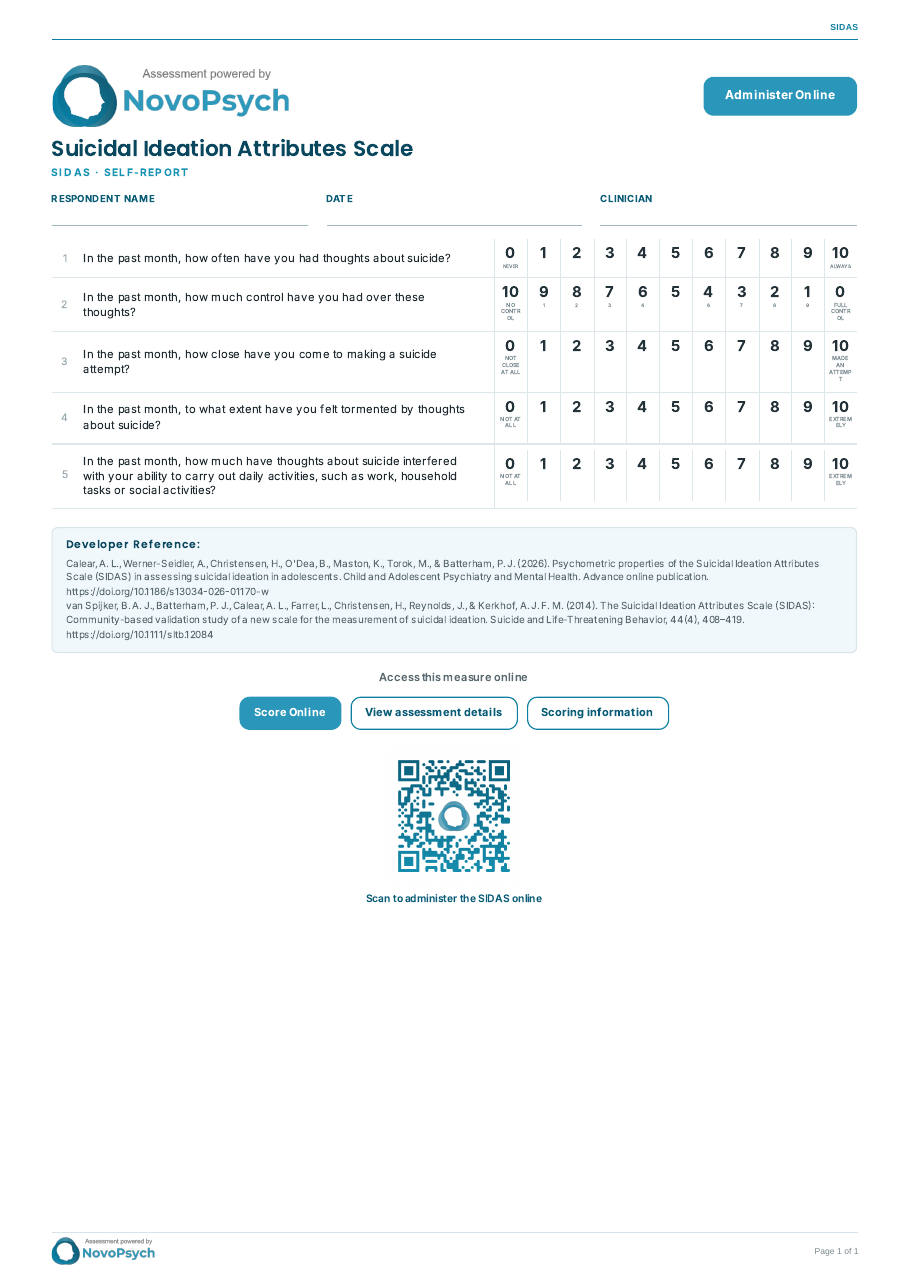
The SIDAS has been validated in adults (van Spijker et al., 2014) and adolescents (Calear et al., 2026), is generally suitable for use from age 13, and was specifically developed for online administration. Most people complete it in under a minute, and those who report no suicidal thoughts finish sooner because they answer only the first question.
Its items cover five attributes of suicidal thoughts:
Screening. The SIDAS can be used at intake, or at any point in care, as a one-minute check on whether a client has had suicidal thoughts in the past month. It identifies clients who report any suicidal thoughts, alerting the clinician that a fuller suicide risk assessment is needed. Research supports following up on any score above 0. In the study that developed the SIDAS, adults who scored above 0 were far more likely to report a suicide plan or suicidal behaviour in the past year (van Spijker et al., 2014). In a study of Australian secondary school students, about two in three who reported a suicide attempt over the following year had scored above 0 (Calear et al., 2026). The other one in three had scored 0, so the SIDAS supports a risk assessment and does not replace it.
Monitoring. The SIDAS can be repeated during care to track whether a client’s suicidal thoughts are easing or getting worse. Each administration covers the past month, so repeats about a month or more apart describe separate periods. In research trials, SIDAS scores have recorded change in both directions. Scores fell further in young adults using a self-guided therapy app than in those using a control app (Torok et al., 2022). In a year-long trial of an online program for adults, repeated scores identified about one in ten participants whose scores rose by more than 6 points (Batterham et al., 2022). Suicidal thoughts can shift considerably over short periods (Calear et al., 2026), so each score is a snapshot of the past month.
Settings. The SIDAS was designed for community and online use (van Spijker et al., 2014) and has since been used across community, outpatient, and inpatient mental health settings. In the UK, it has been used with adults with non-affective psychosis recruited through NHS mental health services, including inpatient and rehabilitation settings (Harris et al., 2021). In Australia, it has been used in headspace, the national youth mental health foundation, and other youth mental health services (Chong et al., 2024), and as an outcome measure in The Way Back, an aftercare service for people referred after a suicide attempt or suicidal crisis (Australian Government Department of Health, 2026).
Each of the five items is rated from 0 to 10. Only the two endpoints are labelled, and the labels vary across items. Respondents who answer “Never” to item 1 skip the remaining items and receive a total score of 0. Because a higher rating on item 2 means more control, that item is reverse-scored, so that less control gives a higher score. The five item scores are then summed into a total score ranging from 0 to 50, with higher scores indicating greater suicidal ideation severity (Australian Government Department of Health, 2021; National Centre for Epidemiology and Population Health, n.d.; van Spijker et al., 2014).
Total score (5 items; items 1–5; total ranging from 0 to 50): the sum of the five items.

The two cut-off scores divide the total score into three severity categories. The categories describe how severe the suicidal thoughts were. They are not levels of risk, and a score below 21 does not indicate low risk.
Individual item responses should also be reviewed alongside the total score. In particular, a respondent may indicate having made a suicide attempt on item 3 even when their total score falls within the “Suicidal ideation present” category (1 to 20). This information warrants clinical follow-up regardless of the total score.
On the first administration of the SIDAS, a horizontal strip shows a box for a score of 0, then the ‘Suicidal ideation present’ and ‘High suicidal ideation’ categories shaded across 1 to 50, with a marker at the total score that shows the score above the strip.

When item 3 is rated 10 (‘Made an attempt’), a note above the graph says that the respondent reported a suicide attempt in the past month.
Multiple administrations of the SIDAS will provide a line graph plotting the total score over time, with the same shading and the same 0 to 50 axis, and a marker that shows the latest score.

On a repeat administration, the report compares the total with both the last and the first administration scores. The report notes when suicidal thoughts were reported at one administration but not the other. A rise of 7 or more points is described as a notable increase (Batterham et al., 2022). This means the rise is large enough that it is unlikely to reflect measurement error alone. The rule was based on reliability in a community sample, and reliability is lower among people with suicidal thoughts. The 7-point figure is a guide, not a firm cut-off, and a smaller rise can still matter.
The SIDAS was developed and validated in a community-based sample of 1,352 Australian adults through an online survey, of whom 560 (41.4%) reported suicidal thoughts in the past month (van Spijker et al., 2014). The five items formed a single factor that accounted for 75.5% of the variance in the full sample and 65.5% among those with suicidal thoughts (van Spijker et al., 2014). Item 2 (controllability) loaded least strongly in both. A later validation in 5,885 Year 8 students from 134 Australian schools, 94% of them aged 13 or 14, supported a single factor once the overlap between items 1 (frequency) and 2 (controllability) was taken into account (Calear et al., 2026).
Internal consistency was high among the 560 adults with suicidal thoughts (α = .86) and in the full adult sample (α = .91; van Spijker et al., 2014). In the adolescent sample, it was α = .90 and ω = .91 (Calear et al., 2026). Test–retest reliability was strong, given that suicidal thoughts can fluctuate markedly over time (Calear et al., 2026). Over 6 weeks, adolescents’ scores correlated .69 overall and .59 among those with suicidal thoughts at baseline (Calear et al., 2026). Over 3 months, scores correlated .73 among the 89 UK adults with non-affective psychosis who completed both assessments. At baseline, 54 of the 99 participants reported suicidal thoughts (Harris et al., 2021). In a trial of an online program for adults with suicidal thoughts, a rise of more than 6 points was used to flag deterioration. The figure was calculated from the SIDAS’s reliability in the development sample (α = .91) and the spread of scores in the trial. In the trial’s own sample, all of whom had suicidal thoughts, internal consistency was lower, at α = .74 (Batterham et al., 2022).
Among adults with suicidal thoughts, the total correlated with the frequency (r = .61), duration (r = .50), and controllability (r = .44) of suicidal ideation on the Columbia-Suicide Severity Rating Scale (van Spijker et al., 2014). In adults with non-affective psychosis, it correlated .72 with the Beck Scale for Suicide Ideation (BSSI) at baseline (Harris et al., 2021). In adolescents, it correlated with depressive symptoms (r = .59) and psychological distress (r = .53; Calear et al., 2026). In the development study, it also correlated with depression (r = .65), anxiety (r = .58), and insomnia severity (r = .40; van Spijker et al., 2014). These moderate to strong correlations support convergent validity. Scores correlated negatively with mental wellbeing in adolescents (r = −.36; Calear et al., 2026) and with resilience in adults with non-affective psychosis (r = −.39; Harris et al., 2021), supporting discriminant validity.
The SIDAS has two cut-off scores: 1 and 21. Each was tested separately as an above-or-below question, and together they form the three severity categories. Both come from the development study in adults (van Spijker et al., 2014). The same cut-offs are used for adolescents, although only the first was supported in that age group (Calear et al., 2026).
The developers proposed 21 or more to indicate high risk of suicidal behaviour, chose it for its specificity, and called for further investigation (van Spijker et al., 2014). Of note, most adults who reported a plan scored below 21, so a score under 21 does not indicate low risk.
In adolescents, any score above 0 indicated increased risk of a later attempt, with no clear difference between lower and higher scores (Calear et al., 2026). Across the developers’ three score groups, the share of adults reporting a suicide plan in the past year rose steeply: 4.0% at 0, 23.7% from 1 to 20, and 64.9% from 21 to 50 (van Spijker et al., 2014). Because the evidence for 21 as a marker of high risk is limited, NovoPsych treats any score above 0 as the marker of risk and uses 21 to describe more severe suicidal ideation.