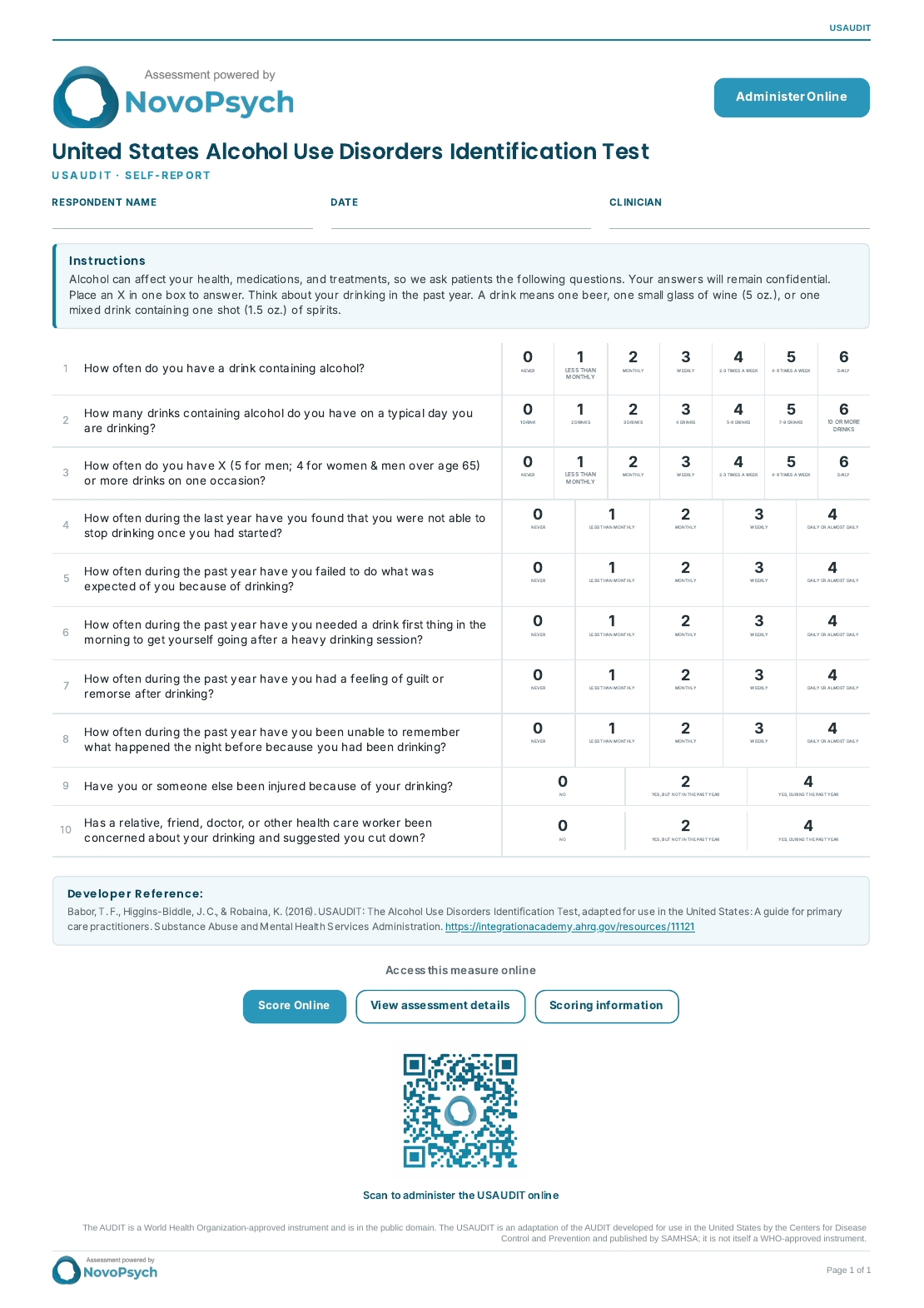
Risky drinking is common. In the 2024 National Survey on Drug Use and Health, 21.7% of US adults reported binge drinking in the past month and 5.5% reported heavy drinking (National Institute on Alcohol Abuse and Alcoholism, 2025a). Binge drinking peaks among young adults aged 18 to 25 (26.7%) but it continues into later life, with 11.4% of adults aged 65 and older reporting it (National Institute on Alcohol Abuse and Alcoholism, 2025b, 2026b).
The USAUDIT and the WHO AUDIT share questions 4 to 10. They differ in questions 1 to 3, which count standard drinks, and so in their score ranges, cutoffs, and zones (Babor et al., 2001, 2016; Higgins-Biddle & Babor, 2018). Choose the version that matches the drink size your client counts in:
| USAUDIT | AUDIT (WHO) | |
|---|---|---|
| Use with | Clients in the United States | Clients outside the United States |
| One standard drink | 14 grams of alcohol: 12 oz of beer, 5 oz of wine, or 1.5 oz of spirits | 10 grams of alcohol |
| Questions 1 to 3 | 7 answer choices each; the binge question asks about 5 or more drinks for men aged 65 and younger, and 4 or more for women and men over 65 | 5 answer choices each; the binge question asks about 6 or more drinks |
| Questions 4 to 10 | Same as the AUDIT | Same as the USAUDIT |
| Total score | 0 to 46 | 0 to 40 |
| Cutoff | 8 for men aged 65 and younger; 7 for women and men over 65 | 8 |
| Zones | I below the cutoff; II cutoff to 15; III 16 to 24; IV 25 to 46 | I 0 to 7; II 8 to 15; III 16 to 19; IV 20 to 40 |
USAUDIT scores and cutoffs are not interchangeable with those of the WHO AUDIT (Higgins-Biddle & Babor, 2018). For clients outside the United States, use the AUDIT.
Drinking above low-risk levels can worsen many common health problems and complicate medical treatment, even when no alcohol use disorder is present (Babor et al., 2016). Binge drinking and heavy drinking also raise the risk of developing AUD over time (National Institute on Alcohol Abuse and Alcoholism, 2026a). Routine screening allows clinicians to intervene early and reduce risks before severe AUD develops (Babor et al., 2016).
About 27 million US adults (10.3%) had AUD in 2024, and only 7.5% of them received any treatment that year (National Institute on Alcohol Abuse and Alcoholism, 2025d, 2026c). Yet when asked, clients are generally open to questions about their alcohol use, receptive to feedback, and show some readiness to change following a positive screen (National Institute on Alcohol Abuse and Alcoholism, 2023). Universal screening can identify individuals who would not otherwise seek help on their own, and as such, national guidance recommends screening all adults aged 18 and older, including pregnant women, in primary care (US Preventive Services Task Force, 2018).
The USAUDIT is used to identify people whose alcohol use may be problematic (Babor et al., 2016). It assesses the pattern and amount of drinking, including binge drinking, along with impairment from and the consequences of alcohol use. Scale results indicate the level of risk and the severity of alcohol use, and whether an alcohol use disorder (AUD) may be present (Babor et al., 2016). It is a screening tool rather than a diagnostic instrument (Babor et al., 2016).
The USAUDIT’s 10 questions fall into three domains that together span drinking patterns, signs of a developing disorder, and harm already experienced (Babor et al., 2016):
A screening and brief intervention tool. Screening, brief intervention, and referral to treatment (SBIRT) is an approach that screens everyone, offers early intervention to people at risk, and refers those with more serious use to treatment (Babor et al., 2007). Within SBIRT, the USAUDIT shows who may benefit from feedback, a brief intervention, or referral for further assessment (Babor et al., 2016).
Settings. The USAUDIT has been studied in US college students (Madson et al., 2020; McCabe et al., 2019; Villarosa-Hurlocker et al., 2020) and in large screening programs in common care settings. These include a federally funded SBIRT program for adults in Virginia, covering emergency departments, urgent care, health clinics, family practices, and free clinics (Peppard et al., 2020). They also include rural primary care (Albright et al., 2021) and reproductive health centers (Vendetti et al., 2025; Waddell et al., 2025).
Reviewing results with the client. The zone links the score to a graded response level from feedback on low-risk drinking through brief intervention to referral for specialist evaluation. Using the zone number rather than a label gives clear, nonjudgmental feedback, and individual answers give concrete points to discuss, such as guilt after drinking or harm from drinking, based on the client’s own responses (Babor et al., 2016). This approach leverages the brief intervention of the SBIRT model, integrating Motivational Interviewing (MI) techniques that rely on personalized feedback and reflective dialogue (Babor et al., 2016), which can increase the client’s “change talk” and contribute to reduced risky drinking behaviors (Magill et al., 2018).
Special situations. Some people are encouraged to avoid alcohol completely, whatever their score, including those who plan to drive or operate machinery, take medications that interact with alcohol, have a medical condition alcohol can aggravate, are younger than the legal drinking age of 21, or are pregnant or may become pregnant (Babor et al., 2016; National Institute on Alcohol Abuse and Alcoholism, 2026a). For pregnant clients, any score of 1 or more is grounds for discussing health risks, including fetal alcohol spectrum disorders (Babor et al., 2016).
Clinician-Administered Interview. An oral interview can accommodate clients with poor reading skills and helps build rapport (Babor et al., 2016). Clients answer most accurately when the setting is friendly and nonthreatening, the questions are linked to their health, they are not under the influence of alcohol or drugs, and they are told their answers are confidential (Babor et al., 2016). Even people most likely to under-report their drinking nearly always screen positive, because they still report drinking above the recommended limits (Babor et al., 2016). Self-report or computer administration takes less clinician time and produces comparable results (Babor et al., 2016).
Before starting the interview, confirm the client’s biological sex and age, because the guide’s drinking limits are lower for women and men over 65 (Babor et al., 2016). Some older adults reach higher blood alcohol levels than younger adults from the same amount of alcohol, so they may develop alcohol-related problems at lower drinking amounts (National Institute on Alcohol Abuse and Alcoholism, 2025c). Men aged 65 and younger are asked about 5 or more drinks on one occasion and have a cutoff of 8. Women, and men over 65, are asked about 4 or more drinks and have a cutoff of 7 (Babor et al., 2016). These binge thresholds are the points at which a typical woman (4 drinks) or man (5 drinks) reaches a blood alcohol concentration of 0.08% within about two hours (National Institute on Alcohol Abuse and Alcoholism, 2026a).
Read the questions as written with attention to the specified time frame of each question asked and follow the skip guideline. If the client answers “Never” to question 1 (no drinking in the past year), skip to questions 9 and 10. These ask about injury and others’ concern about drinking at any time, so they can identify previous problems with alcohol use and risk if the client returns to drinking (Babor et al., 2016). Questions 1 to 3 depend on counting standard drinks, and using typical examples of what the equivalency of one alcoholic beverage is, or a graphic illustration is useful for accurate responses (Babor et al., 2016).
The USAUDIT produces a total score that places the respondent in a risk zone, and flags a positive result on its first three questions (the USAUDIT-C). Higher scores indicate more drinking and more alcohol-related problems.
Total score. The USAUDIT Total score is the sum of all 10 questions (10 items; questions 1 to 10; total ranging from 0 to 46).

The total score places the respondent in one of four zones, each with the severity level the developers aligned with DSM-5 (Babor et al., 2016). The cutoff between Zone I and Zone II is 8 for men aged 65 and younger and 7 for everyone else.
| Zone | Severity level | Men aged 65 and younger | Everyone else | What it reflects |
|---|---|---|---|---|
| Zone I | None/Low Risk | 0 to 7 | 0 to 6 | Lower-risk drinking or abstinence, with no alcohol use disorder indicated |
| Zone II | Mild | 8 to 15 | 7 to 15 | Drinking above the low-risk limits, where health risks begin; approximately mild alcohol use disorder |
| Zone III | Moderate | 16 to 24 | 16 to 24 | Early alcohol-related harm; approximately moderate alcohol use disorder |
| Zone IV | Moderate/Severe | 25 to 46 | 25 to 46 | Approximately moderate to severe alcohol use disorder |
Questions 9 and 10 score harm at any time, so past harm can place a respondent in Zone II when questions 1 to 3 are below the USAUDIT-C cutoff. A few answer patterns can exceed the low-risk limits but score below the cutoff (Babor et al., 2016; Higgins-Biddle & Babor, 2018). Where the answers clearly exceed the limits, the results show the weekly line (more than 14 drinks a week for men aged 65 and younger, or 7 for everyone else) or the binge line (any binge drinking), whatever the zone.
The first three questions are often used on their own as a first-stage screen (Babor et al., 2016; Zoorob et al., 2017), so a positive result on them is flagged to show that drinking alone exceeds the NIAAA low-risk limits, before the remaining questions are considered. A score of 7 or more on these questions for women and men over 65, or 8 or more for men aged 65 and younger, is “a positive risk indicator” (Babor et al., 2016).
If the respondent reports no drinking in the past year (question 1 = “Never”), questions 2 to 8 are skipped and the form moves to questions 9 and 10. Skipped questions are scored 0, and the total score range remains 0 to 46. Skipped questions appear in the Client Responses table as grayed-out rows with no answer selected, and the report notes that they were not asked because no drinking was reported in the past year, not as missing data.

The developers group the questions into three conceptual domains to identify clients who are drinking above recommended levels, already have some symptoms of a possible alcohol use disorder, or may recognize problems with their drinking, information that helps clients cut down and avoid harm (Babor et al., 2016). The domains are not based on a factor analysis and are not scored:
The report shows one result per domain. Hazardous Alcohol Use is positive when questions 1 to 3 reach the USAUDIT-C cutoff. Dependence Symptoms and Harmful Alcohol Use read “Yes” when any of their questions is answered other than “Never” or “No” (Babor et al., 2016).

Each answer is reported, since all responses guide management (Babor et al., 2016).
The report’s interpretive text opens with the date, the total score, and the zone, followed by what the zone reflects and the response the developers pair with it. When the lower cutoff of 7 is applied because sex or age cannot set the limits (gender recorded as gender diverse, no gender recorded, or a man with no date of birth), the report says so and why. A positive USAUDIT-C is shown as a bold “USAUDIT-C Positive Risk Indicator” label. The weekly line and the binge line follow when the answers to questions 1 to 3 show them.
Endorsed answers on questions 4 to 8 are listed with how often each occurred, and any endorsement of questions 4 to 6 adds a prompt to ask about the most recent alcohol-free day and any withdrawal symptoms (Babor et al., 2016). Questions 9 and 10 are reported as current or past harm. Every scored report closes with the developers’ note on avoiding alcohol in risky situations and in pregnancy. Questions not endorsed are not mentioned, and the report does not diagnose.
From the second administration, the report graphs the total score at each administration against the four zones, and graphs each endorsed question separately. The developers recommend re-screening annually, as drinking habits change over time (Babor et al., 2016), and Medicare covers a yearly screen (Centers for Medicare & Medicaid Services, 2011). Change in either direction can guide reassessment of risk level. No change scores are reported, because the questions cover the past year and no test-retest reliability or reliable change values are available for the USAUDIT.
At the first administration, the total score is shown as a single vertical bar on an axis from 0 to 46. Behind the bar, the axis is shaded in four bands, one for each zone and labeled by severity level: Zone I unshaded, Zone II in amber, Zone III in light red, and Zone IV in a deeper red. The boundary between Zone I and Zone II sits at the respondent’s own cutoff of 7 or 8.

From the second administration, a line graph shows the total score at each administration against the same bands, with a caption noting that each USAUDIT covers the past year.

A small graph for each question shows that question’s score at each administration, grouped under the three domains, on the question’s own scores (0 to 6 for questions 1 to 3, 0 to 4 for questions 4 to 8, and 0, 2, or 4 for questions 9 and 10). The domains are graphed question by question rather than as totals, because the developers read them by question (Babor et al., 2016). A question with no score above 0 at any administration shown is named in a note instead of being graphed. When question 1 is “Never”, questions 2 to 8 are not asked and count as 0.

The USAUDIT is the WHO AUDIT adapted to US drinking standards. The WHO version’s first three questions assume a smaller standard drink (10 grams of alcohol, compared with 14 grams in the US) and a binge threshold of 6 drinks, so they do not match US limits and produce many false positives (Babor et al., 2016; Higgins-Biddle & Babor, 2018). The USAUDIT changes only these three questions, matching them to US drink sizes and limits, with a binge question of 5 drinks for men and 4 for women and men over 65 (Babor et al., 2016). Each of these questions also expands from 5 to 7 answer choices, for a more precise measure of how often and how much the client drinks (Higgins-Biddle & Babor, 2018). Questions 4 to 10 are unchanged (Babor et al., 2016). As a result, USAUDIT scores and cutoffs are not interchangeable with those of the WHO AUDIT (Higgins-Biddle & Babor, 2018).
Internal consistency of the USAUDIT total is acceptable in college students, with alphas of .79 and .76 (Madson et al., 2020; McCabe et al., 2019). It is stronger in other adult samples, including young adults, Hispanic women with a history of intimate partner violence, and adults recruited online, with USAUDIT alphas of .86 to .91 (Agley et al., 2022; Davidson et al., 2025; Jessen, 2026). Across these samples, the 10 questions show they are reliable enough to be summed into a single total score.
The USAUDIT total accurately identifies drinking above recommended limits and is somewhat less accurate for possible alcohol use disorder. In 250 undergraduates, using self-reported criteria, the USAUDIT total identified frequent binge drinkers with an area under the curve (AUC) of .96 and likely AUD with an AUC of .80 (McCabe et al., 2019). Among college student drinkers, the USAUDIT AUC was .84 for drinking above any NIAAA limit (Madson et al., 2020). A reanalysis of the same students compared the USAUDIT with an 11-item self-report checklist of the DSM-5 alcohol use disorder criteria, counting two or more symptoms as potential AUD, and found an AUC of .82, showing that USAUDIT scores track DSM-5 symptoms of alcohol use disorder (Villarosa-Hurlocker et al., 2020). The USAUDIT was at least as accurate as the WHO AUDIT in these students (AUC .84 vs .79; Madson et al., 2020), with no significant difference in the reanalysis (Villarosa-Hurlocker et al., 2020), supporting the developers’ view that it maintains the WHO AUDIT’s accuracy (Babor et al., 2016). The first three questions alone were less accurate for potential AUD than all 10, so the USAUDIT-C flag shows drinking above the limits, while the total is the better guide to possible AUD (Villarosa-Hurlocker et al., 2020).
Outside college samples, mean USAUDIT scores were similar across Black, Hispanic, and White young adults, though measurement equivalence has not been tested (Davidson et al., 2025). In an online adult sample from a data-quality trial, scores correlated moderately with depression and anxiety (Agley et al., 2022). In a statewide SBIRT program, USAUDIT totals fell by an average of 5.8 points six months after an alcohol intervention among 147 adults followed up, though there was no comparison group and people at higher risk were less likely to complete follow-up (Peppard et al., 2020). Among the studies reviewed, the USAUDIT has not been compared against structured diagnostic interviews, so higher scores indicate more severe alcohol use symptoms rather than a probability of diagnosis.
The USAUDIT cutoffs of 7 and 8 mark the point where reported drinking goes above the NIAAA low-risk limits. A score at or above the cutoff means the client’s drinking has likely passed the level where health risks begin. A score below it usually suggests lower-risk drinking (Babor et al., 2016; Higgins-Biddle & Babor, 2018). Those limits, in place when the guide was written, were no more than 3 drinks a day or 7 a week for women and men over 65, and 4 a day or 14 a week for men aged 65 and younger (Babor et al., 2016). The cutoffs were set to match them, so the cutoff is lower for women and men over 65 (Babor et al., 2016). NIAAA’s current pages define binge and heavy drinking but no longer list low-risk limits (National Institute on Alcohol Abuse and Alcoholism, 2026a). Because the cutoffs follow the limits, the developers expect few false positives (Babor et al., 2016). A few answer patterns that exceed the limits still score below the cutoff, so a negative USAUDIT-C does not rule out drinking above the limits (Higgins-Biddle & Babor, 2018). The CDC guide applies the cutoffs differently: it uses 8 for everyone on the full 10 questions, keeps 7 for women and men over 65 only for questions 1 to 3, and starts its top zone at 20 rather than 25 (Centers for Disease Control and Prevention, 2014).
The cutoffs have been examined in primary care and in college students. In 4,023 rural primary care patients, the USAUDIT cutoffs applied to its three drinking questions produced no false positives and identified 103 of the 133 patients drinking above US limits, confirming that they track the NIAAA limits (Albright et al., 2021). In college students, the USAUDIT total cutoffs were mostly adequate for risky drinking, with sensitivity of .50 to .74 and specificity of .82 to 1.00, and for possible AUD they picked up most students who met the criteria (sensitivity .72 to .88) but with more false positives (specificity .38 to .78) (Madson et al., 2020; McCabe et al., 2019; Villarosa-Hurlocker et al., 2020). Both college studies found lower cutoffs worked better in students (Madson et al., 2020; McCabe et al., 2019), so the standard cutoffs may miss some at-risk student drinkers.
The developers divide the total score into four zones: Zone I below the cutoff, Zone II from the cutoff to 15, Zone III from 16 to 24, and Zone IV from 25 to 46, which they aligned approximately with DSM-5 severity levels (Babor et al., 2016). The guide notes little research on the cutoffs for Zones III and IV (Babor et al., 2016). Among the studies reviewed, none has tested these two boundaries on the USAUDIT.