El consumo de riesgo de alcohol es habitual. En la Encuesta Nacional sobre el Consumo de Drogas y la Salud de 2024, el 21,7 % de los adultos estadounidenses declaró haber consumido alcohol de forma compulsiva en el último mes y el 5,5 % declaró haber consumido alcohol en exceso (Instituto Nacional sobre el Abuso del Alcohol y el Alcoholismo, 2025a). El consumo excesivo de alcohol alcanza su punto álgido entre los adultos jóvenes de entre 18 y 25 años (26,7 %), pero se mantiene en edades más avanzadas, ya que el 11,4 % de los adultos de 65 años o más lo declara (Instituto Nacional sobre el Abuso del Alcohol y el Alcoholismo, 2025b, 2026b).
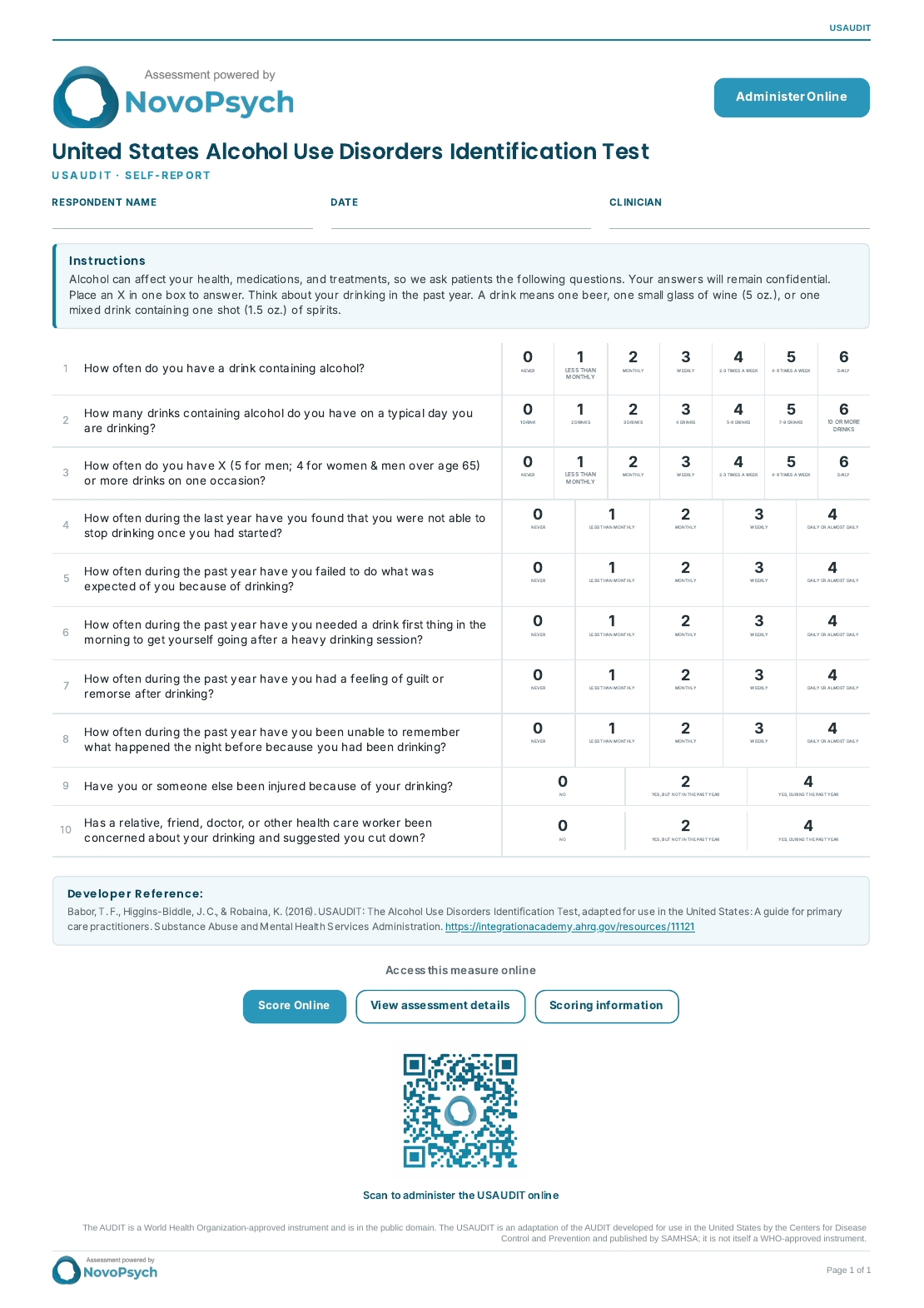
El USAUDIT y el AUDIT de la OMS comparten las preguntas del 4 al 10. Se diferencian en las preguntas del 1 al 3, que contabilizan las bebidas estándar, y, por lo tanto, en sus rangos de puntuación, valores de corte y zonas (Babor et al., 2001, 2016; Higgins-Biddle y Babor, 2018). Elige la versión que se ajuste al tamaño de las bebidas que contabiliza tu cliente:
| USAUDIT | AUDITORÍA (OMS) | |
|---|---|---|
| Utilizar con | Clientes en Estados Unidos | Clientes fuera de Estados Unidos |
| Una bebida estándar | 14 gramos de alcohol: 12 onzas de cerveza, 5 onzas de vino o 1,5 onzas de licores | 10 gramos de alcohol |
| Preguntas 1 a 3 | 7 opciones de respuesta cada una; la pregunta sobre el consumo excesivo se refiere a 5 o más bebidas alcohólicas en el caso de los hombres de 65 años o menos, y a 4 o más en el caso de las mujeres y los hombres mayores de 65 años | Cada pregunta tiene 5 opciones de respuesta; la pregunta sobre el consumo excesivo se refiere a 6 o más bebidas. |
| Preguntas del 4 al 10 | Igual que la AUDIT | Igual que el USAUDIT |
| Puntuación total | De 0 a 46 | De 0 a 40 |
| Límite | 8 para los hombres de 65 años o menos; 7 para las mujeres y los hombres mayores de 65 años | 8 |
| Zonas | I: por debajo del umbral; II: del umbral hasta 15; III: de 16 a 24; IV: de 25 a 46 | I: de 0 a 7; II: de 8 a 15; III: de 16 a 19; IV: de 20 a 40 |
Las puntuaciones y los valores de corte del USAUDIT no son intercambiables con los del AUDIT de la OMS (Higgins-Biddle y Babor, 2018). Para los pacientes que no residen en Estados Unidos, utilice el AUDIT.
Beber por encima de los niveles de bajo riesgo puede agravar muchos problemas de salud comunes y complicar el tratamiento médico, incluso cuando no existe un trastorno por consumo de alcohol (Babor et al., 2016). El consumo excesivo de alcohol y el consumo intensivo también aumentan el riesgo de desarrollar un trastorno por consumo de alcohol (AUD) con el tiempo (Instituto Nacional sobre el Abuso del Alcohol y el Alcoholismo, 2026a). Las pruebas de detección rutinarias permiten a los profesionales sanitarios intervenir de forma temprana y reducir los riesgos antes de que se desarrolle un AUD grave (Babor et al., 2016).
En 2024, unos 27 millones de adultos estadounidenses (el 10,3 %) padecían un trastorno por consumo de alcohol (AUD), y solo el 7,5 % de ellos recibió algún tipo de tratamiento ese año (Instituto Nacional sobre el Abuso del Alcohol y el Alcoholismo, 2025d, 2026c). Sin embargo, cuando se les pregunta, los pacientes suelen mostrarse abiertos a las preguntas sobre su consumo de alcohol, receptivos a los comentarios y muestran cierta disposición a cambiar tras un resultado positivo en la prueba de detección (Instituto Nacional sobre el Abuso del Alcohol y el Alcoholismo, 2023). El cribado universal permite identificar a personas que, de otro modo, no buscarían ayuda por iniciativa propia; por ello, las directrices nacionales recomiendan realizar el cribado a todos los adultos mayores de 18 años, incluidas las mujeres embarazadas, en la atención primaria (Grupo de Trabajo de Servicios Preventivos de EE. UU., 2018).
El USAUDIT se utiliza para identificar a las personas cuyo consumo de alcohol puede ser problemático (Babor et al., 2016). Evalúa el patrón y la cantidad de consumo de alcohol, incluido el consumo excesivo, así como el deterioro y las consecuencias derivadas del consumo de alcohol. Los resultados de la escala indican el nivel de riesgo y la gravedad del consumo de alcohol, así como si puede existir un trastorno por consumo de alcohol (AUD) (Babor et al., 2016). Se trata de una herramienta de cribado más que de un instrumento de diagnóstico (Babor et al., 2016).
Las 10 preguntas del USAUDIT se agrupan en tres ámbitos que, en conjunto, abarcan los hábitos de consumo de alcohol, los indicios de un trastorno en fase de desarrollo y los daños ya sufridos (Babor et al., 2016):
Una herramienta de cribado e intervención breve. El cribado, la intervención breve y la derivación al tratamiento (SBIRT) es un enfoque que permite realizar un cribado a todas las personas, ofrecer una intervención temprana a aquellas en situación de riesgo y derivar a quienes presentan un consumo más grave al tratamiento (Babor et al., 2007). En el marco del SBIRT, el USAUDIT permite identificar a quienes pueden beneficiarse de una retroalimentación, una intervención breve o una derivación para una evaluación más exhaustiva (Babor et al., 2016).
Entornos. El USAUDIT se ha estudiado en estudiantes universitarios de EE. UU. (Madson et al., 2020; McCabe et al., 2019; Villarosa-Hurlocker et al., 2020) y en programas de cribado a gran escala en entornos de atención sanitaria habituales. Entre ellos se incluye un programa SBIRT financiado con fondos federales para adultos en Virginia, que abarca servicios de urgencias, atención de urgencia, centros de salud, consultas de medicina familiar y clínicas gratuitas (Peppard et al., 2020). También se incluyen la atención primaria en zonas rurales (Albright et al., 2021) y los centros de salud reproductiva (Vendetti et al., 2025; Waddell et al., 2025).
Revisión de los resultados con el cliente. La zona vincula la puntuación a un nivel de respuesta graduado, que abarca desde comentarios sobre el consumo de alcohol de bajo riesgo, pasando por una intervención breve, hasta la derivación para una evaluación especializada. El uso del número de zona en lugar de una etiqueta proporciona una retroalimentación clara y sin juicios de valor, y las respuestas individuales ofrecen puntos concretos de debate, como la culpa tras beber o los daños derivados del consumo de alcohol, basados en las propias respuestas del cliente (Babor et al., 2016). Este enfoque aprovecha la intervención breve del modelo SBIRT, integrando técnicas de Entrevista Motivacional (EM) que se basan en comentarios personalizados y en un diálogo reflexivo (Babor et al., 2016), lo que puede aumentar el «discurso de cambio» del cliente y contribuir a reducir las conductas de consumo de riesgo (Magill et al., 2018).
Situaciones especiales. Se recomienda a algunas personas que eviten el alcohol por completo, independientemente de su puntuación, entre ellas aquellas que tengan previsto conducir o manejar maquinaria, que tomen medicamentos que interactúen con el alcohol, que padezcan una afección médica que el alcohol pueda agravar, que sean menores de 21 años (la edad mínima legal para consumir alcohol), o que estén embarazadas o puedan quedarse embarazadas (Babor et al., 2016; Instituto Nacional sobre el Abuso del Alcohol y el Alcoholismo, 2026a). En el caso de las clientas embarazadas, cualquier puntuación de 1 o más es motivo para abordar los riesgos para la salud, incluidos los trastornos del espectro alcohólico fetal (Babor et al., 2016).
Entrevista realizada por un profesional sanitario. Una entrevista oral puede adaptarse a los pacientes con dificultades de lectura y ayuda a establecer una buena relación (Babor et al., 2016). Los pacientes responden con mayor precisión cuando el entorno es agradable y no intimidatorio, las preguntas están relacionadas con su salud, no se encuentran bajo los efectos del alcohol o las drogas y se les informa de que sus respuestas son confidenciales (Babor et al., 2016). Incluso las personas con mayor probabilidad de subestimar su consumo de alcohol casi siempre dan positivo en la evaluación, ya que siguen declarando un consumo superior a los límites recomendados (Babor et al., 2016). La autoevaluación o la administración por ordenador requieren menos tiempo por parte del profesional sanitario y producen resultados comparables (Babor et al., 2016).
Antes de comenzar la entrevista, confirma el sexo biológico y la edad del cliente, ya que los límites de consumo establecidos en la guía son más bajos para las mujeres y los hombres mayores de 65 años (Babor et al., 2016). Algunas personas mayores alcanzan niveles de alcohol en sangre más elevados que los adultos más jóvenes con la misma cantidad de alcohol, por lo que pueden desarrollar problemas relacionados con el alcohol con cantidades menores de consumo (Instituto Nacional sobre el Abuso del Alcohol y el Alcoholismo, 2025c). A los hombres de 65 años o menos se les pregunta si han tomado 5 o más bebidas alcohólicas en una sola ocasión y su umbral de consumo excesivo es de 8. A las mujeres y a los hombres mayores de 65 años se les pregunta si han tomado 4 o más bebidas alcohólicas y su umbral de consumo excesivo es de 7 (Babor et al., 2016). Estos umbrales de consumo excesivo son los puntos en los que una mujer típica (4 bebidas) o un hombre típico (5 bebidas) alcanza una concentración de alcohol en sangre del 0,08 % en unas dos horas (Instituto Nacional sobre el Abuso del Alcohol y el Alcoholismo, 2026a).
Lee las preguntas tal y como están redactadas, prestando atención al intervalo de tiempo especificado para cada una de ellas, y sigue las instrucciones para saltarlas. Si el cliente responde «Nunca» a la pregunta 1 (no ha consumido alcohol en el último año), pasa directamente a las preguntas 9 y 10. Estas preguntas se refieren a lesiones y a la preocupación de otras personas por el consumo de alcohol en cualquier momento, por lo que permiten identificar problemas previos relacionados con el consumo de alcohol y el riesgo en caso de que el cliente vuelva a beber (Babor et al., 2016). Las preguntas 1 a 3 se basan en el recuento de bebidas estándar, por lo que resulta útil utilizar ejemplos típicos de lo que equivale una bebida alcohólica o una ilustración gráfica para obtener respuestas precisas (Babor et al., 2016).
El USAUDIT genera una puntuación total que clasifica al encuestado en una zona de riesgo y señala un resultado positivo en sus tres primeras preguntas (el USAUDIT-C). Las puntuaciones más altas indican un mayor consumo de alcohol y más problemas relacionados con el alcohol.
Puntuación total. La puntuación total del USAUDIT es la suma de las 10 preguntas (10 ítems; preguntas del 1 al 10; puntuación total comprendida entre 0 y 46).

La puntuación total sitúa al encuestado en una de las cuatro zonas, cada una de las cuales tiene un nivel de gravedad que los autores han alineado con el DSM-5 (Babor et al., 2016). El umbral entre la Zona I y la Zona II es de 8 para los hombres de 65 años o menos y de 7 para el resto de personas.
| Zona | Nivel de gravedad | Hombres de 65 años o menos | Todos los demás | Lo que refleja |
|---|---|---|---|---|
| Zona I | Sin riesgo o riesgo bajo | De 0 a 7 | De 0 a 6 | Consumo de alcohol de bajo riesgo o abstinencia, sin indicios de trastorno por consumo de alcohol |
| Zona II | Leve | De 8 a 15 | De 7 a 15 | Consumo de alcohol por encima de los límites de bajo riesgo, a partir de los cuales comienzan los riesgos para la salud; lo que equivale aproximadamente a un trastorno leve por consumo de alcohol |
| Zona III | Moderado | De 16 a 24 | De 16 a 24 | Daños tempranos relacionados con el alcohol; trastorno por consumo de alcohol de gravedad aproximadamente moderada |
| Zona IV | Moderado/Grave | De 25 a 46 | De 25 a 46 | Trastorno por consumo de alcohol de gravedad aproximadamente moderada a grave |
Las preguntas 9 y 10 evalúan el daño en cualquier momento, por lo que el daño pasado puede situar a un encuestado en la Zona II cuando las preguntas 1 a 3 se sitúan por debajo del umbral del USAUDIT-C. Algunos patrones de respuesta pueden superar los límites de bajo riesgo, pero obtener una puntuación inferior al umbral (Babor et al., 2016; Higgins-Biddle y Babor, 2018). Cuando las respuestas superan claramente los límites, los resultados muestran la línea semanal (más de 14 bebidas a la semana para hombres de 65 años o menos, o 7 para el resto de personas) o la línea de consumo excesivo (cualquier episodio de consumo excesivo de alcohol), independientemente de la zona.
Las tres primeras preguntas suelen utilizarse por sí solas como cribado de primera fase (Babor et al., 2016; Zoorob et al., 2017), por lo que un resultado positivo en ellas se señala para indicar que el consumo de alcohol por sí solo supera los límites de bajo riesgo del NIAAA, antes de tener en cuenta el resto de preguntas. Una puntuación de 7 o más en estas preguntas para mujeres y hombres mayores de 65 años, o de 8 o más para hombres de 65 años o menos, constituye «un indicador de riesgo positivo» (Babor et al., 2016).
Si el encuestado indica que no ha consumido alcohol en el último año (pregunta 1 = «Nunca»), se omiten las preguntas 2 a 8 y el formulario pasa a las preguntas 9 y 10. Las preguntas omitidas se puntúan con un 0, y el rango de puntuación total sigue siendo de 0 a 46. Las preguntas omitidas aparecen en la tabla «Respuestas del cliente» como filas en gris sin respuesta seleccionada, y el informe señala que no se formularon porque no se declaró haber consumido alcohol en el último año, y no como datos faltantes.

Los autores agrupan las preguntas en tres ámbitos conceptuales para identificar a los pacientes que beben por encima de los niveles recomendados, que ya presentan algunos síntomas de un posible trastorno por consumo de alcohol o que pueden reconocer problemas con su consumo de alcohol, información que ayuda a los pacientes a reducir el consumo y evitar daños (Babor et al., 2016). Estos ámbitos no se basan en un análisis factorial y no se puntúan:
El informe muestra un resultado por cada ámbito. El «consumo peligroso de alcohol» se considera positivo cuando las preguntas 1 a 3 alcanzan el umbral establecido por el USAUDIT-C. Los «síntomas de dependencia» y el «consumo nocivo de alcohol» se consideran «Sí» cuando se responde a cualquiera de sus preguntas con una opción distinta de «Nunca» o «No» (Babor et al., 2016).

Se recoge cada respuesta, ya que todas ellas sirven de orientación para la gestión (Babor et al., 2016).
El texto interpretativo del informe comienza con la fecha, la puntuación total y la zona, seguidos de lo que refleja dicha zona y la respuesta que los desarrolladores le asignan. Cuando se aplica el umbral mínimo de 7 debido a que el sexo o la edad no pueden establecer los límites (género registrado como «género diverso», sin género registrado o un hombre sin fecha de nacimiento), el informe lo indica y explica el motivo. Un resultado positivo en el USAUDIT-C se muestra con la etiqueta en negrita «Indicador de riesgo positivo del USAUDIT-C». A continuación aparecen las líneas de consumo semanal y de consumo excesivo cuando así lo indican las respuestas a las preguntas 1 a 3.
Las respuestas seleccionadas para las preguntas 4 a 8 se enumeran junto con la frecuencia con la que se produjeron, y cualquier respuesta seleccionada en las preguntas 4 a 6 añade una indicación para preguntar por el último día sin alcohol y por cualquier síntoma de abstinencia (Babor et al., 2016). Las preguntas 9 y 10 se registran como daños actuales o pasados. Cada informe puntuado concluye con una nota de los autores sobre cómo evitar el consumo de alcohol en situaciones de riesgo y durante el embarazo. No se mencionan las preguntas que no han recibido respuesta, y el informe no establece ningún diagnóstico.
A partir de la segunda aplicación, el informe representa gráficamente la puntuación total de cada aplicación en relación con las cuatro zonas, y muestra por separado cada pregunta a la que se ha respondido afirmativamente. Los autores recomiendan realizar una nueva evaluación anualmente, ya que los hábitos de consumo de alcohol cambian con el tiempo (Babor et al., 2016), y Medicare cubre una evaluación anual (Centros de Servicios de Medicare y Medicaid, 2011). Cualquier cambio, en cualquier sentido, puede servir de guía para reevaluar el nivel de riesgo. No se indican puntuaciones de «sin cambios», ya que las preguntas se refieren al último año y no se dispone de valores de fiabilidad test-retest ni de cambio fiable para el USAUDIT.
En la primera aplicación, la puntuación total se muestra como una única barra vertical en un eje que va de 0 a 46. Detrás de la barra, el eje aparece sombreado en cuatro franjas, una por cada zona, etiquetadas según el nivel de gravedad: la Zona I sin sombrear, la Zona II en ámbar, la Zona III en rojo claro y la Zona IV en un rojo más intenso. El límite entre la Zona I y la Zona II se sitúa en el umbral establecido por el propio encuestado, que es 7 u 8.

A partir de la segunda evaluación, un gráfico lineal muestra la puntuación total de cada evaluación en relación con los mismos rangos, con una leyenda en la que se indica que cada USAUDIT abarca el último año.

Un pequeño gráfico para cada pregunta muestra la puntuación de dicha pregunta en cada administración, agrupada según los tres ámbitos, en función de las propias puntuaciones de la pregunta (de 0 a 6 para las preguntas 1 a 3, de 0 a 4 para las preguntas 4 a 8, y 0, 2 o 4 para las preguntas 9 y 10). Los dominios se representan gráficamente pregunta por pregunta, en lugar de como totales, ya que los autores del estudio los interpretan pregunta por pregunta (Babor et al., 2016). Las preguntas que no obtienen una puntuación superior a 0 en ninguna de las administraciones mostradas se indican en una nota, en lugar de representarse gráficamente. Cuando la respuesta a la pregunta 1 es «Nunca», las preguntas 2 a 8 no se formulan y se contabilizan como 0.

El USAUDIT es la versión del AUDIT de la OMS adaptada a los estándares de consumo de alcohol de EE. UU. Las tres primeras preguntas de la versión de la OMS parten de una unidad de bebida estándar más pequeña (10 gramos de alcohol, frente a los 14 gramos de EE. UU.) y de un umbral de consumo excesivo de 6 bebidas, por lo que no se ajustan a los límites estadounidenses y generan muchos falsos positivos (Babor et al., 2016; Higgins-Biddle y Babor, 2018). El USAUDIT modifica únicamente estas tres preguntas, adaptándolas a los tamaños de las bebidas y a los límites estadounidenses, con un umbral de consumo excesivo de 5 bebidas para los hombres y de 4 para las mujeres y los hombres mayores de 65 años (Babor et al., 2016). Cada una de estas preguntas también amplía las opciones de respuesta de 5 a 7, para obtener una medida más precisa de la frecuencia y la cantidad que bebe el paciente (Higgins-Biddle y Babor, 2018). Las preguntas 4 a 10 no han sufrido cambios (Babor et al., 2016). Como resultado, las puntuaciones y los umbrales del USAUDIT no son intercambiables con los del AUDIT de la OMS (Higgins-Biddle y Babor, 2018).
La consistencia interna del total del USAUDIT es aceptable en estudiantes universitarios, con coeficientes alfa de 0,79 y 0,76 (Madson et al., 2020; McCabe et al., 2019). Es mayor en otras muestras de adultos, incluidos los adultos jóvenes, las mujeres hispanas con antecedentes de violencia de pareja y los adultos reclutados en línea, con coeficientes alfa del USAUDIT de entre 0,86 y 0,91 (Agley et al., 2022; Davidson et al., 2025; Jessen, 2026). En todas estas muestras, las 10 preguntas demuestran ser lo suficientemente fiables como para ser sumadas en una única puntuación total.
La puntuación total del USAUDIT identifica con precisión el consumo de alcohol por encima de los límites recomendados, aunque su precisión es algo menor a la hora de detectar un posible trastorno por consumo de alcohol. En una muestra de 250 estudiantes universitarios, utilizando criterios basados en la información facilitada por los propios participantes, la puntuación total del USAUDIT identificó a los bebedores compulsivos frecuentes con un área bajo la curva (AUC) de 0,96 y a los que probablemente padecían un trastorno por consumo de alcohol con un AUC de 0,80 (McCabe et al., 2019). Entre los estudiantes universitarios que consumen alcohol, el AUC del USAUDIT fue de 0,84 para el consumo por encima de cualquier límite establecido por la NIAAA (Madson et al., 2020). Un nuevo análisis de los mismos estudiantes comparó el USAUDIT con una lista de autocontrol de 11 ítems basada en los criterios del DSM-5 para el trastorno por consumo de alcohol, en la que se consideraban dos o más síntomas como un posible trastorno por consumo de alcohol, y encontró un AUC de 0,82, lo que demuestra que las puntuaciones del USAUDIT reflejan los síntomas del trastorno por consumo de alcohol según el DSM-5 (Villarosa-Hurlocker et al., 2020). El USAUDIT resultó al menos tan preciso como el AUDIT de la OMS en estos estudiantes (AUC de 0,84 frente a 0,79; Madson et al., 2020), sin diferencias significativas en el reanálisis (Villarosa-Hurlocker et al., 2020), lo que respalda la opinión de los desarrolladores de que mantiene la precisión del AUDIT de la OMS (Babor et al., 2016). Las tres primeras preguntas por sí solas resultaron menos precisas para detectar un posible trastorno por consumo de alcohol (AUD) que las diez en su conjunto, por lo que la señal de alerta del USAUDIT-C indica un consumo de alcohol por encima de los límites, mientras que la puntuación total constituye la mejor guía para detectar un posible AUD (Villarosa-Hurlocker et al., 2020).
Fuera de las muestras universitarias, las puntuaciones medias del USAUDIT fueron similares entre los jóvenes adultos negros, hispanos y blancos, aunque no se ha comprobado la equivalencia de la medición (Davidson et al., 2025). En una muestra de adultos en línea procedente de un ensayo sobre la calidad de los datos, las puntuaciones se correlacionaron moderadamente con la depresión y la ansiedad (Agley et al., 2022). En un programa SBIRT a escala estatal, las puntuaciones totales del USAUDIT descendieron una media de 5,8 puntos seis meses después de una intervención sobre el consumo de alcohol entre los 147 adultos a los que se realizó un seguimiento, aunque no hubo un grupo de comparación y las personas con mayor riesgo eran menos propensas a completar el seguimiento (Peppard et al., 2020). Entre los estudios revisados, el USAUDIT no se ha comparado con entrevistas diagnósticas estructuradas, por lo que las puntuaciones más altas indican síntomas de consumo de alcohol más graves, más que una probabilidad de diagnóstico.
Los umbrales de 7 y 8 del USAUDIT marcan el punto en el que el consumo de alcohol declarado supera los límites de bajo riesgo establecidos por el NIAAA. Una puntuación igual o superior al umbral significa que es probable que el consumo de alcohol del paciente haya superado el nivel a partir del cual comienzan los riesgos para la salud. Una puntuación inferior suele indicar un consumo de bajo riesgo (Babor et al., 2016; Higgins-Biddle y Babor, 2018). Esos límites, vigentes en el momento de redactarse la guía, no superaban las 3 bebidas al día o las 7 a la semana para mujeres y hombres mayores de 65 años, y las 4 al día o las 14 a la semana para hombres de 65 años o menos (Babor et al., 2016). Los umbrales se fijaron para ajustarse a ellos, por lo que el umbral es más bajo para las mujeres y los hombres mayores de 65 años (Babor et al., 2016). Las páginas actuales del NIAAA definen el consumo excesivo y el consumo intensivo de alcohol, pero ya no incluyen los límites de bajo riesgo (Instituto Nacional sobre el Abuso del Alcohol y el Alcoholismo, 2026a). Dado que los umbrales siguen los límites, los autores del cuestionario esperan que haya pocos falsos positivos (Babor et al., 2016). Algunos patrones de respuesta que superan los límites siguen obteniendo una puntuación por debajo del umbral, por lo que un resultado negativo en el USAUDIT-C no descarta un consumo superior a los límites (Higgins-Biddle y Babor, 2018). La guía de los CDC aplica los valores de corte de forma diferente: utiliza un 8 para todas las personas en las 10 preguntas completas, mantiene un 7 para las mujeres y los hombres mayores de 65 años únicamente en las preguntas 1 a 3, y establece el inicio de su zona máxima en 20 en lugar de en 25 (Centros para el Control y la Prevención de Enfermedades, 2014).
Los valores de corte se han analizado en la atención primaria y en estudiantes universitarios. En una muestra de 4.023 pacientes de atención primaria de zonas rurales, los valores de corte del USAUDIT aplicados a sus tres preguntas sobre el consumo de alcohol no produjeron falsos positivos e identificaron a 103 de los 133 pacientes que consumían por encima de los límites estadounidenses, lo que confirma que se ajustan a los límites del NIAAA (Albright et al., 2021). En el caso de los estudiantes universitarios, los umbrales totales del USAUDIT resultaron en su mayoría adecuados para detectar el consumo de riesgo, con una sensibilidad de entre 0,50 y 0,74 y una especificidad de entre 0,82 y 1,00; en cuanto al posible trastorno por consumo de alcohol (AUD), detectaron a la mayoría de los estudiantes que cumplían los criterios (sensibilidad de entre 0,72 y 0,88), aunque con más falsos positivos (especificidad de entre 0,38 y 0,78) (Madson et al., 2020; McCabe et al., 2019; Villarosa-Hurlocker et al., 2020). Ambos estudios universitarios concluyeron que los umbrales más bajos funcionaban mejor en los estudiantes (Madson et al., 2020; McCabe et al., 2019), por lo que los umbrales estándar podrían pasar por alto a algunos estudiantes bebedores en situación de riesgo.
Los autores dividen la puntuación total en cuatro zonas: la Zona I, por debajo del umbral; la Zona II, desde el umbral hasta 15; la Zona III, de 16 a 24; y la Zona IV, de 25 a 46, que han alineado aproximadamente con los niveles de gravedad del DSM-5 (Babor et al., 2016). La guía señala que hay pocos estudios sobre los umbrales de las zonas III y IV (Babor et al., 2016). Entre los estudios revisados, ninguno ha evaluado estos dos umbrales en el USAUDIT.