

La Escala de Personalidad de Cinco Factores de NovoPsych – 30 (NFFPS-30; Buchanan & Hegarty, 2023) evalúa las características de personalidad para los siguientes factores:

La escala puede ser útil para comprender los rasgos generales de clientes, estudiantes, pacientes y colegas, tanto en entornos de salud mental como en ambientes no clínicos. Los resultados pueden proporcionarse directamente al encuestado y pueden ayudar a ofrecer retroalimentación y autoexploración, o servir como apoyo en formulaciones clínicas.
Los rasgos de personalidad son importantes para numerosos resultados vitales y han demostrado validez predictiva en resultados subjetivos como las relaciones y el bienestar (Roberts et al., 2007). Los rasgos también se relacionan con una variedad de resultados vitales objetivos, como los ingresos anuales y el nivel educativo en muestras a nivel nacional (p. ej., Kajonius & Carlander, 2017). Además, los rasgos de personalidad parecen estar adquiriendo mayor importancia en los contextos de individualismo de la sociedad moderna (Skirbekk & Blekesaune, 2014) y son bastante estables y se desarrollan de manera predecible a lo largo de la vida (Briley & Tucker-Drob, 2014).
La personalidad se mide con mayor frecuencia mediante el modelo de los cinco factores (FFM; McCrae, 2010). Este modelo representa regularidades de pensamientos, sentimientos y comportamientos en los individuos, expresadas en cinco factores de rasgos amplios: (1) Apertura a la experiencia, (2) Conciencia, (3) Extraversión, (4) Amabilidad y (5) Neuroticismo. Estos rasgos son a menudo conocidos por el acrónimo OCEAN.
El FFM ha sido objeto de especial atención en entornos clínicos desde la inclusión de los rasgos de personalidad en el DSM-5 (American Psychiatric Association, 2013; Strus, Cieciuch, & Rowiński, 2014). Muchos psicólogos hoy en día coinciden en que el marco del FFM puede utilizarse como base para integrar rasgos de personalidad comunes y anormales (Markon, Krueger, & Watson, 2005).
Organizar la personalidad en cinco factores de rasgos suele ser demasiado general para ciertos propósitos. Por lo tanto, el NFFPS-30 separa cada uno de los cinco factores en seis facetas de personalidad subyacentes y más específicas. Las facetas permiten una mayor precisión de análisis (véase Ziegler & Bäckström, 2016) y describen disposiciones hacia ciertos comportamientos, afectos y cogniciones dentro de cada dominio factorial (véase Zillig, Hemenover, & Dienstbier, 2002).
Por ejemplo, un descriptor de personalidad amplio como la Extraversión podría indicar que la persona es sociable, feliz, enérgica o dominante, o todas estas características. En otras palabras, el alcance y el significado del término Extraversión no poseen un alto nivel de especificidad. Otro ejemplo de definición multifacética es la Apertura a la experiencia. Existen varios rasgos de faceta específicos de orden inferior que podrían ser más informativos, como la Aventura al predecir la tendencia a viajar, o el Intelecto al predecir la elección de la educación.
Apertura a la Experiencia: Mide la receptividad a nuevas ideas, la imaginación y la curiosidad intelectual.
Conciencia: Refleja cuán organizada, responsable y orientada a objetivos es una persona.
Extraversión: Mide el grado en que una persona es extrovertida, enérgica y sociable.
Amabilidad: Evalúa el nivel de compasión, cooperación y cordialidad en un individuo.
Neuroticismo: Evalúa la estabilidad emocional, los niveles de ansiedad y la sensibilidad al estrés.
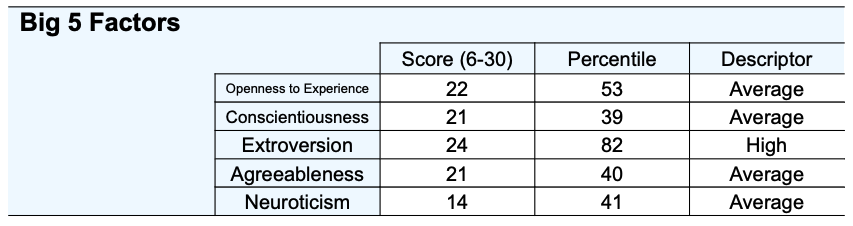
Estos factores y facetas proporcionan una evaluación exhaustiva de los rasgos de personalidad de un individuo y ayudan a los profesionales a obtener información sobre diversos aspectos del comportamiento y las preferencias de un individuo.
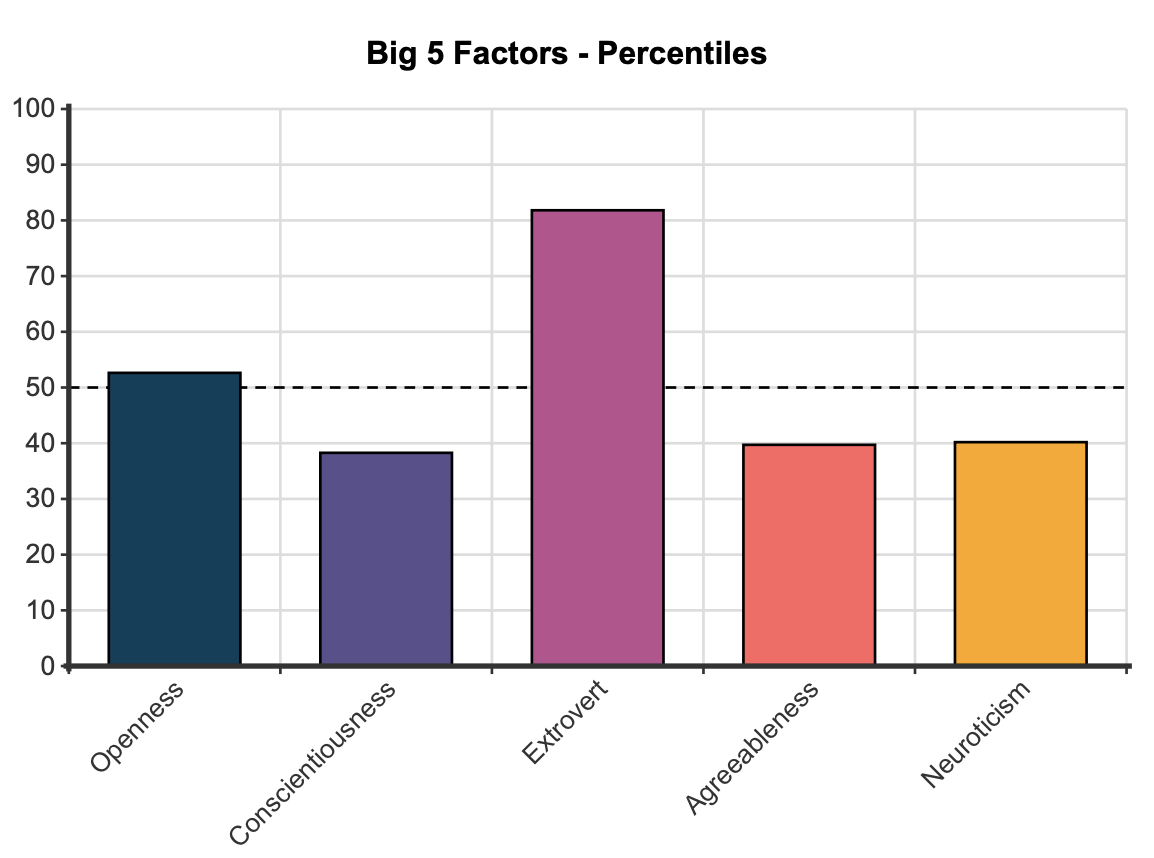
Se presentan percentiles para cada uno de los factores y facetas de los rasgos, comparando las puntuaciones del encuestado con las de una muestra australiana relacionada con la edad y el género (análisis de NovoPsych de los datos de Johnson 2020). Un percentil de 50 representa patrones típicos de respuesta en comparación con sus pares. También se presentan descriptores para cada factor y faceta, considerándose "Alto" si la puntuación está en el 30% superior en comparación con sus pares, "Bajo" si está en el 30% inferior o "Promedio" si está en el 40% intermedio (es decir, "Alto" si el percentil es 70 o superior, "Bajo" si el percentil es 30 o inferior, o "Promedio" si el percentil está entre 30 y 70). Los percentiles se basan en el género y la edad, que se categorizaron en siete grupos de edad.
On a facet level, percentiles may be presented with > or < symbols. This indicates that the top (>) or bottom (<) percentile rank has been reached due to ceiling or floor effects for that facet. Given that facets are derived from single items, caution is recommended when interpreting facet scores.
En el informe narrativo, también se pueden presentar 'tipos de patrones' (si existen puntuaciones altas y bajas en los factores de personalidad). Estos 'tipos de patrones' se basan en el modelo de personalidad del Circunplejo Abreviado de los Cinco Grandes Factores (AB5C; Hofstee, de Raad, & Goldberg, 1992). Estas descripciones se basan en las proporcionadas por Johnson (s.f.).
El NFFPS-30 es una versión abreviada del IPIP-NEO-120. El IPIP-NEO-120 es un producto del proyecto de colaboración International Personality Item Pool (IPIP; Goldberg et al., 2006) y es una representación disponible públicamente del modelo de medición de cinco factores (Johnson, 2014), extrayendo 120 ítems del International Personality Item Pool (IPIP; Goldberg et al., 2006).
El NFFPS-30 fue creado para optimizar su longitud, manteniendo al mismo tiempo una fuerte correlación con el IPIP-NEO-120 en la medición del modelo de cinco factores (FFM). Para acortar el IPIP-NEO-120, NovoPsych realizó un AFC utilizando el repositorio de datos IPIP-NEO de Johnson (Johnson, 2020). Las estadísticas de ajuste para el AFC se presentan en el sitio web de NovoPsych (ver aquí). Como resultado del AFC, se mantuvo el ítem que cargó más alto en cada faceta, con un ítem por faceta y manteniendo la misma estructura de seis facetas por factor que el IPIP-NEO-120. Las correlaciones entre los factores del NFFPS-30 y el IPIP-NEO-120 (y sus facetas correspondientes) fueron las siguientes:
Se recopilaron datos normativos del repositorio de datos IPIP-NEO de Johnson (Johnson, 2020) para permitir el cálculo de percentiles. Estos datos fueron analizados por NovoPsych para determinar normas apropiadas utilizando encuestados australianos. Los datos iniciales del repositorio (N = 619.150) se filtraron primero para corregir algunos errores de datos donde las respuestas eran 0 para algunas preguntas (dado que las respuestas a las preguntas deben ser de 1 a 5) y, si alguna fila contenía un 0 en una respuesta, se eliminó la fila completa (n resultante = 410.376). La edad de los clientes se utilizó luego para eliminar los datos de los clientes menores de 16 años (n resultante = 385.902) y, posteriormente, los datos se filtraron para incluir solo aquellos en los que el encuestado se encontraba en Australia (n resultante = 14.163).
Estos participantes estaban compuestos por 5,252 hombres (entre 16 y 95 años) y 8,911 mujeres (entre 16 y 88 años). Dado que la edad de los participantes presentaba un sesgo positivo, con una edad media de 26.9 años, los datos se categorizaron en grupos de edad para permitir grupos de tamaño aproximadamente igual (n ~ 2,000) para la comparación. Los grupos de edad resultantes fueron: 16-17 años (n = 2,509), 18-19 años (n = 2,279), 20-21 años (n = 1,624), 22-25 años (n = 1,742), 26-30 años (n = 2,032), 31-39 años (n = 2,128) y 40 años o más (n = 1,849).
Posteriormente, se crearon percentiles para cada factor y faceta, basados en el género y la edad, utilizando el programa estadístico R (Versión 4.2.0; R Core Team, 2022) y el paquete cNORM (Versión 3.0.2; Lenhard & Lenhard, 2021). Este método de normalización estima los percentiles a partir de los datos brutos sin requerir suposiciones sobre la distribución de los mismos. Dicho método minimiza el sesgo derivado del error de muestreo y medición, al tiempo que gestiona desviaciones marcadas de la normalidad, aborda los efectos de suelo o techo y captura casi toda la varianza en la muestra original de datos normativos (Lenhard & Lenhard, 2021).


